28.5.10

22.5.10
the deletions goes to cockatoo island
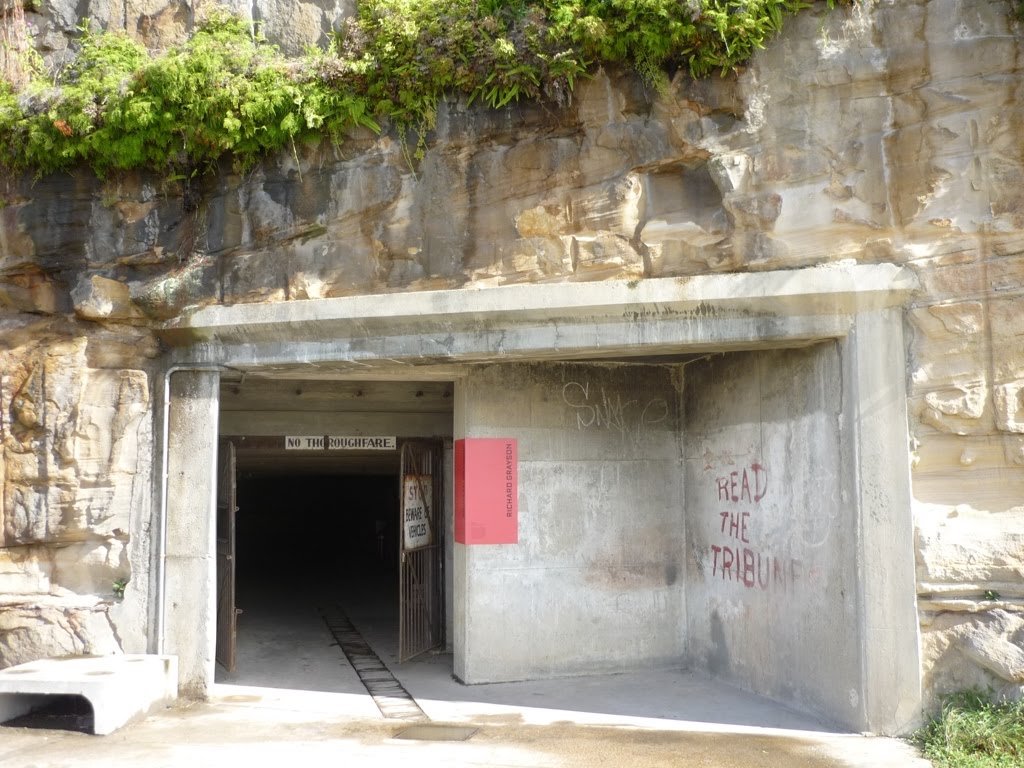
 Richard Grayson’s 2004 piece Messiah is somewhere inside that cliff -
 here’s the entrance
 It's The Midnight Amblers singing a country song about Jesus on dvd.
 Yellow singalong text obscured.
Are they mocking The Messiah? Yes they are.
 ha! that was funny sort of
 through to more art ...
Stay tuned - deflated inflatable still to come -
it was going to be ‘a must see’-
Brook Andrew’s Jumping Castle War Memorial

after only one week (& 2 months still to go) - collapso.
no bouncies - under a forlorn tarpaulin

Dale Frank’s resin paintings look comfy in this messy old turbine hall
(note to designers - replicate for Darling Point living room walls)

lights powered by…

Cai Guo-Qiang hangs up and illuminates real cars, but it doesn’t matter

There was much more to experience (and wonder why) on Cockatoo Island,
a small selection of almost perfunctory 'Asian' pieces in the main foyer
at the Art Gallery of NSW,
but, so far, the best of the Sydney Biennale art is at the MCA
with Art Space and the Botanic Gardens to come ...
20.5.10


16.5.10

10.4.10
soi 3 modern poets,
an imprint of Papertiger Media, presents -
AUTHENTIC LOCAL
a new collection of poetry by Pam Brown

Pam Brown’s poetry attends to the soundbites and transitoriness of contemporary Australian life. Her dazzling wordplay gives us glistening souvenirs of overblown politik-speak, uncontrolled Western consumption, and the daze of the habitual and housetrained. Rather than timeshare the modernist experiment, Brown moves beyond its heroics and fashions a commentary that is understated, down to earth, and unsettling. While questioning its own title, what remains marvelled at in ‘Authentic Local’ is the colloquial and its uncanniness, the utopic harbour glimpse of a home language. - Ann Vickery
This book complements the collection True Thoughts, published by Salt Modern Poets in 2008. Authentic Local collects around fifty poems written in the years between 2002 and 2005, most of which were put aside whilst compiling the selection for True Thoughts. To read Ken Bolton and Carl Harrison-Ford on True Thoughts click here. Read Tim Wright on the same collection here. A number of recent poems are included in Authentic Local alongside the earlier material.
The title reflects a consistent irony that is threaded throughout the poems. An ‘authentic local’, like a Benjaminesque restless cosmopolitan, can inhabit any place at any time and for any period of time. So these poems are variously located.
These deceptively minimalist poems are layered in a kind of eclectic tumble. They are only seemingly autobiographical as they cruise through sharply delineated street-scapes, food courts, imagined havens, distant places, through encounters with friends, through lost and ordinary cities, through wit, boredom, disillusion, nostalgia, paranoia, irony. Always irony, and perhaps also a sense of the ludicrous, as they attempt to fathom the question ‘how to live?’ alongside the larger one ‘how to live now?’
The pastiche of this group of poems addresses (among other things) the concept that the ‘self’ is never fixed, that it is a slippery notion and that it is perhaps nothing much more than a daily work of bricolage. The poems are energised by dualities : self-deprecating wit coupled with associated knowledge and depth, the mundane and the illuminated morphing together textually, the local (Australian) and the international quizzically extemporized via things and moods, and via moments of brief existential measuring. The energy in the use of dualities together with an avoidance of placing judgement enables a discovery of beauty in the various contrasting ideas in this manuscript. Encompassing opposing ideals of academic and domestic, foreign and familiar, the poems are always at odds with the ‘lyrical’ and yet they are lyrically engaged.
What else can you do in the face of dark times (permanent war, floundering science, haywire climate), and your experience of this as unspectacular, utilitarian and silencing, but disrupt that silence and search for and imagine a role. One thing you can do as a poet is turn irony back on yourself and write poems made as if from particles that offer a range of trajectories arcing off into open space, that might evoke in a reader action and reaction.
These poems hope to never fail to give – and to give generously with humour and acuity from a tempered, critical and ultimately optimistic delight in the oddness of the world.
For more information, or to buy a copy of the book
contact Pam Brown.
Three poems from Authentic Local -
NEWS & SPORTS

by the radio:
I mishear the news and sports presenter
say ‘the latest in nuisance sports’,
outside the light is green,
the lightning frightening      stay away
from windows       but the storm
takes no notice of me and my black Bic biro
here at the kitchen table
with a new biography of Dante – ‘Dante;
The Poet, The Political Thinker, The Man’ –
I’d just begun reading twenty minutes ago,
the cover image, a detail from a portrait of him,
one book open as he turns
to consult another, open and propped
up against two others, leather-bound,
he has the poet’s leafy laurel twig
tucked into his familiar red headscarf.
poetry is like
tv’s live coverage and if you change
a particle you can arrive at an elegant result
via electronic properties and, probably,
high conductivity in an electrical storm,
but the computer is down and so am I –
my bad handwriting taxes my energy,
how does my brain put up with it ?
(who am I to ask?)
this almost illegible notation driven into
the empty moments between a book
and a book, a poem ‘made in situ’,
the phrase imagined
as a t-shirt slogan or a label
but handwritten
SISTER MORPHEME

excipient ties, like ell oh vee ee,
   leaving
       nothing to chance

I always
        wanted
to plagiarise you

sleeping, you were ill,
       and smelt like a mineral,
                 but different

at the start
       your subwoofer
   shook me to my microbes,
emergency exits
         opened in my night

 I loved to you a woman
     as I returned your sounds
          from phone to morph

slippery gleams
      slithered into darkness,
your fermented prosody
                 ripe for traffic
SELF DENIAL NEVER LASTS LONG

very busy here
finishing up a 900 page epic poem I've been working on off
& on for
25 years!

telereal

I am
kind of continental

I want to come back as
a false witness

your gifts of cheap software
cannot compensate

what is
mazarine
what is
teazle

frowsty hairdo

it worked for the chimp

good to be young, indiscriminate, finding out,
with time to
BROWSE

then,
after the libidinal,
twenty years of scooping

locate
a happy go lucky cunt, a lookalike

now, there’s
your fillip

this is the stich
section

picking at the price sticker,
everything must go !
8.4.10
New from Jacket Magazine

Visit the new 900-page issue - Jacket 39
Click here
Feature: Ron Silliman
Feature: Nathaniel Tarn
Feature: Bob Perelman
Feature: Douglas Barbour
Sister Sites: Vincent Katz on 'Vanitas' magazine
Interview: James Sherry
Interview and poems: Bob Arnold
Mark Silverberg:
The New York School Poets and the Neo-avant-garde:
Introduction: “A Lot of Guys Who Know All About Bricks”
Feature: Rewriting Canonical Australian Poems
Poems: Bob Arnold, Aaron Belz, Vincent Katz, Robert VanderMolen
Reviews of books by Rae Armantrout, Eric Baus, Miles Champion, Kevin Davies, Carla Harryman, Larry Price, Susan Howe and Simon Pettet
And for news about Jacket's exciting future, see the homepage here
Editors: John Tranter, Pam Brown
6.4.10

1.4.10

29.3.10
I heard the Canadian poet Christian Bök talking about his latest inspirational art-science project in an extensive radio interview with Joe Milford recently. Here’s the link to that conversation.
 Deinococcus radiodurans
This article about the project is from the io9 website -
The Roman poet Horace once said of his works that "I have created a monument more lasting than bronze." Well, Canadian poet Christian Bök has pretty much blown Horace away with his plan to encode a poem into bacterial DNA.
The plan is simple enough, if completely insane. Bök hopes to inject a series of nucleotides into the DNA of the bacteria Deinococcus radiodurans that form an intelligible poem, and then, in case that was too easy, he wants the protein the bacteria manufactures to also form a meaningful poem.
Since he only has four characters to work with - the nucleotides adenine, cytosine, guanine, and thymine - he first needs to create an alphabet that substitutes various triplets of nucleotides in the place of the twenty-six letters. In other words, AGT might correspond to "a", while CTG could mean "b", and so on. However, Bök can't just choose the triplets at random, because for all the trillions of possible combinations, only a minuscule fraction will produce amino acids that also yields a workable vocabulary.
Bök is currently using specially designed software to find the optimal arrangement, and only once he's figured that out will he actually write the poem. He has said that he will be somewhat limited in what sort of poetry he can write, and that most likely he will compose something with a "repetitive, incantatory quality."
Once all that's done, it's up to lab technicians to string together the right nucleotides and inject them into Deinococcus radiodurans. It won't be easy and may take several attempts, but the potential legacy of such a project is almost incomprehensible. If Bök's poem nucleotides take hold in Deinococcus radiodurans, there's no reason to think they won't hang around for the lifespan of the species.
And considering there's also no reason to think this strain of bacteria will ever go extinct (or at least last until the Sun destroys the Earth five billion years from now)...well, there's an excellent chance that Bök's poem will eventually be the last evidence of humanity's existence left on planet Earth. I imagine Horace would approve.
21.3.10
Vagabond Press
celebrates the release of two exciting new poetry titles:

A Whistled Bit of Bop - new collection by Ken Bolton
&
Bonny Cassidy’s first chapbook Said To Be Standing
Sunday 18th April
2 for 2:30pm
Upstairs at The Rose Hotel,
Corner Cleveland & Shepherd Sts
Chippendale
Sydney
drinks, pizza, poetry
everyone welcome
26.2.10
Trans Tasman Poetry

HOME & AWAY 2010
The New Zealand Electronic Poetry Centre - nzepc - is planning a two-part symposium in Auckland and Sydney. The first part of HOME & AWAY 2010 will feature readings, launches and forum-style talks with trans Tasman colleagues at the University of Auckland 30-31 March. For details of the program visit this site
We will also establish a digital bridge and invite poets and others to contribute text, images, audio or video that reflects or extends the symposium's trans Tasman focus. Another round of contributions to the bridge will be uploaded as HOME & AWAY convenes in Sydney 1-2 September. In this way we hope to create two-way traffic between points in time and places where poets connect.
Anyone interested in poetry and its current conversations can send a submission to the digital bridge. Submissions will be considered by an editorial team and you will be notified when your contribution has been accepted or declined. For further information on the digital component click here.
Poems and prose (prose no longer than 2000 words please) should be sent to nzepc@auckland.ac.nz as attached files. If you are sending images, audio or video check with us about suitable formats for upload. Submissions should reach us by 15 April for inclusion in the first upload, and by 15 August for the second. You should be the copyright holder of the material you are submitting.
The bridge will go live 30 March 2010.
Michele Leggott and Brian Flaherty, Pam Brown and Martin Edmond,
editors for NZ Electronic Poetry Centre (nzepc)
21.2.10

Patti Smith. What can I say? ‘Pissing in A River’ was my theme song in the mid 70s. I scrawled the song title in big black texta letters on the interior roof panel of my VW station wagon. The album ‘Horses’ had the same inspirational effect on me when I first heard it as Bob Dylan’s ‘The Times They Are A-Changin’ had when I was at high school in 1964. That is, I was, in the vernacular of the times, blown away. I still own my copy of Patti’s first single - ‘Piss Factory’/’Hey Joe’ - a rare item now, that she and Lenny Kaye made with Tom Verlaine and then, as Mer records, had it pressed in a limited edition of 1500 in Philadelphia in 1974.

I had read her poetry books, ‘Witt’, ‘Seventh Heaven’, ‘Ha Ha Houdini’ before I heard the music. I loved her books for their New York feel, for their look and style more than the actual poems. Patti Smith always tended towards the just-post-beat mystical and I was becoming interested then in a more hard-edged scepticism, and anyway, in Australia the mystical was for hippies in Nimbin communes. I had been fascinated, as many kids in their late teens/early twenties were, by the experimentation and seeming rebellion and freedom of the underground punk & poetry scene that followed on from the Beats in New York in the late 60s/early 70s.

Patti Smith, cover photo for Horses by Robert Mapplethorpe, 1975
Just Kids is a memoir of Patti Smith’s early days with her lover and close friend Robert Mapplethorpe as they survive on part-time jobs in bookshops and hustle for dinner and rent and a room at the Chelsea as they gradually figure out how to become artists in New York City. Although she slips into occasional purple patches her generosity and openness here make this an honest and totally engaging memoir. It’s her gift to her soul mate, Robert Mapplethorpe, the visual artist and photographer who died of AIDS at the age of 42 in 1989.
I know I am totally unobjective about Patti Smith. When I saw her perform at the Enmore Theatre in 1997 during her first visit to Sydney, her raw power was extraordinary - her work had definitely deepened and strengthened as she had aged. On that tour, she read poems to a small audience one Sunday morning at the Museum of Contemporary Art. No celebrity artifice, just the poet and the work - it was brilliant.
Here’s Edmund White’s review of Just Kids
9.2.10

Out of the Box: Contemporary Australian Gay and Lesbian Poets
edited by Michael Farrell & Jill Jones
published by Puncher & Wattmann
Book launch with talks by
Michael Kirby & Anna Gibbs
Poetry readings by Kate Lilley, Martin Harrison, Chris Edwards, Andy Quan, Kerry Leves, Tricia Dearborn, Keri Glastonbury, Tim Denoon, Joanne Burns, Jenni Nixon, Dennis Gallagher, Paul Knobel, Louise Wakeling, Carolyn Gerrish, Jill Jones and Michael Farrell.
Other poets in the anthology include David Malouf, Dorothy Porter, Pam Brown, Lee Cataldi, Wendy Jenkins, Peter Rose, Angela Gardner, Miriel Lenore, Bel Schenk, Dipti Saravanamuttu, Scott-Patrick Mitchell, and others.
Friday 26th Feb, 6pm
Foyer, York Theatre
The Seymour Centre
Cnr Cleveland St & City Road,
Chippendale, Sydney
5.2.10
Jacket magazine to move in January 2011
An Announcement from John Tranter and Al Filreis
Dear friends:
We are writing with news of a transition we both deem very exciting.
By the end of 2010, John Tranter and Pam Brown will have put out 40 issues of Jacket (jacketmagazine.com). It began in what John recalls as "a rash moment" in 1997 - an early all-online magazine, one of the earliest in the world of poetry and poetics, and quite rare for its consistency over the years. "The design is beautiful, the contents awesomely voluminous, the slant international modernist and experimental." (So said The Guardian.)
After issue 40, John will retire from thirteen years of intense every-single-day involvement with Jacket, and the entire archive of thousands of web pages will move intact to servers at the University of Pennsylvania in Philadelphia, where it will of course be available on the internet to everyone, for free, as always. But the magazine is not ceasing publication: quite the opposite.

Starting with the first issue in 2011, Jacket will have a new home, extra staff and a vigorous future as Jacket2. Jacket and its continuation, Jacket2, will be hosted by the Kelly Writers House and PennSound at the University of Pennsylvania.
The connection with PennSound, a vast and growing archive of audio recordings of poetry performance, discussion and criticism, is seen as a valuable additional facet of the new magazine, as is the relationship with busy Kelly Writers House, a lively venue for day-to-day poetic interchange of all kinds. The synergy in this three-way relationship has great potential.
Al will become Publisher and Jessica Lowenthal, Director of the Writers House, will be Associate Publisher. The new Editor will be Michael S. Hennessey (currently Managing Editor of PennSound) and the new Managing Editor will be Julia Bloch. John will be available as Founding Editor, and Pam will continue as Associate Editor.
More news about Jacket2 in the weeks and months to come. Meantime, the Jacket2 folks extend gratitude -- as many in the world of poetics do -- to John and to Pam Brown for the extraordinary work they've done. And John, for his part, is mightily pleased that Jacket will be preserved and will continue and grow in a somewhat new mode but with a continuous mission and approach.
- John Tranter & Al Filreis
Jacket Magazine
click on the names for links:
Al Filreis
Kelly Writers House
Jessica Lowenthal, Kelly Writers House Director
Michael S. Hennessey
Julia Bloch
Pam Brown
John Tranter
Note from Pam Brown, Associate Editor : - I welcome this move to the University of Pennsylvania and its many attendant connections with contemporary poetry. I feel enthused by the upcoming changes. I'll be staying on with 'Jacket2' and plan to edit Australian/NZ/AsianAustn/Southern Pacific material as a sweep of whatever has poetic currency in this region at the time.
22.1.10

Wakefield Press invites you to the launch of
The Circus
by Ken Bolton, illustrated by Michael Fitzjames
to be launched by Deborah Welch,
General Manager of Radio Adelaide
A small circus arrives near Trieste - Strong Man, lion, ballerina - from these elements is constructed a contemporary idyll of troubled beauty and humour. What is life about? Was that man shot from a cannon? Should one visit The Tent of Curiosities? Crucially, 'Have you got your ticket?' With a nod to Robbe-Grillet’s Jealousy and to The Umbrellas of Cherbourg, and yet another to A Bad Day for The Sung Dynasty, The Circus succeeds in being entirely original.
Thursday 4 February, 6.00 pm for 6.30 pm
Australian Experimental Art Foundation Bookshop,
Lion Arts Centre,
between Mercury Cinema and Jam Factory,
cnr North Tce and Morphett St, Adelaide.
Books will be on sale and wines served courtesy of Fox Creek Wines

15.1.10
Yesterday at the cinema I was transported back to almost thirty years ago to when I worked at the experimental art foundation in Adelaide, South Australia where I met and worked with a remarkable group of people from Broome, Western Australia. I had gone to see the film Bran Nue Dae.

 Ernie Dingo as Uncle Tadpole
The official web site tells the story - “Bran Nue Dae has a long and influential history in Australia: first as a collection of iconic songs, then as a stage musical that toured Australia in the early 1990’s charming audiences wherever it played.
Set in the summer of 1969, the story of Bran Nue Dae was inspired by the teenage experiences of writer and musician Jimmy Chi and the members of the band kuckles - Patrick Duttoo Bin Amat, Garry Gower, Michael Manolis Mavromatis and Stephen Pigram - who grew up in the tropical seaside port of Broome on Australia’s west coast….”
I was privileged to meet and work closely with the Broome Aboriginal Arts Group and Jimmy Chi when they were artists-in-residence at the E.A.F. in 1981. Members of the band ‘kuckles’ were concurrently studying at the Centre for Aboriginal Studies in Music in Adelaide. Here, Jimmy and the band made the first recordings of the songs that have continued to be sung and performed for three decades now.


For me, the experience of working with the Broome people was a very positive one. And yesterday I felt happily moved by the film so I began looking around in my cupboards for remnants of those days. If you’re interested, you’ll have to click on the scans of articles here in order to read them. My apologies for the low tech..
 note by David Kerr, eaf Director, in 'A Decade at the E.A.F. 1974-1984', edited by Stephanie Britton
 my article in 'Art Network', issue 3/4, 1981, edited by Ross Wolfe
Here's to Jimmy Chi, Kuckles, The Pigram Brothers, Geoff Buchan, Jane Sindel, the EAF and the film director Rachel Perkins and the cast and crew of Bran Nue Dae!
Jesse Glass of Ahadada Books is pleased to present
the meh of z z z z by Pam Brown.

Further information and free download HERE
Author info HERE
The cover art (click the image above to enlarge) is by Margaret Schnipper, a New York based photographer, film writer/director and visual artist.
See more of her work HERE
9.1.10

4.1.10
New Year Poetry Mash Up
Here it is again -
 the book I recommended on this blog in October 2009 as an instance of lyrical poetic writing that might be of some reflective and stimulating use to Australian poets interested in lyrical writing. I've since removed that blog. Even though some contributors did actually address the topic of current lyric poetry in Australia in what became a mostly dire, befuddled mish mash of comments, I’m pretty certain that no one who participated has bothered to read this book.
Here is a very recent post about the book from Tinfish editor, poet, critic and academic Susan Schultz’s blog :
The other book that launches me from one "low, dishonest decade" into this next (if you think the decade has, in fact, ended) is Claudia Rankine's DON'T LET ME BE LONELY. While the book was published in 2004 (by Graywolf), it reads as an elegy to the aughts, whose tone was set early. Y2K was the false, comedic crisis that 9/11 became, and 9/11 has stayed with us for a long decade. Rankine's "lyric" is, in fact, a book of prose. The back cover calls it "lyric essay/poetry," which reminds me how much I prefer the term "meditation." "Lyric essay" seems another marker of the selling of genres as teachable units; it's a subset of "creative non-fiction," after all. But that's enough complaining. Rankine's work is forensic, getting at our most public moments by way of her most private ones. Not only does she share family stories with her reader, some of them tragic, but she also examines the effects of American life on the inner organs--the brain, the breast, the liver. Medicine is part of this narrative, though any link between medicine and healing is not as neat as one might hope (against hope). The link between human value and that assigned by the insurance industry is even more troubling. The book is held together by the ever-symbolic television screen, that place where our private and public lives most often meet, as we sit (mostly) passively to receive them. Our passivity is what makes us most ill. To meditate upon the public event and the poet's private (very physical) reponses to it is to re-take some notion of agency (though that word loses agency as I type).
DON'T LET ME BE LONELY appears as a billboard in a field of sunflowers on the cover of Rankine's book. It's an unlikely billboard, this private call of anguish set beside a main road (which is empty, save for a thicket of signs.) There's a sense of public obscurity about the clear, private anguish that is the book's subject. While Rankine quotes Levinas on "being for the other," she frames that quotation with assertions of loneliness. And so, on page 120, she begins, "Then all life is a form of waiting, but it is the waiting of loneliness. One waits to recognize the other, to see the other as one sees the self." Then, she quotes the other, Levinas:
"The subject who speaks is situated in relation to the other. This privilege of the other ceases to be incomprehensible once we admit that the first fact of existence is neither being in itself nor being for itself but being for the other, in other words, that human existence is a creature. By offering a word, the subject putting himself forward lays himself open and, in a sense, prays." (120)
I am reminded just now of the hilltops of Rwanda in the mid-90s, during the genocide, when thousands of people milled about, stunned, hungry, and the eye of the media turned itself on them. There was a correspondent for ABC news whose face was narrow, hair gray, voice melancholy. I sat and cried at the images as he spoke into the camera's eye, which mediated between me and him, him and the story he was paid to tell us. Over the course of days, weeks, the correspondent's face fell, his voice began to quiver. I don't remember which gave way first, the correspondent's psyche or the short attention span of the media. But one day they were both gone from my screen. I was alone again, without him, without them. Levinas is surely right about self and other, the word, the prayer that links us. But what if we are all behind television (or computer) screens and our words are spoken only to ourselves? That kind of privacy is hellish. [I google Rwanda and eventually come up with the name of that correspondent, Jim Wooten.]
But Rankine turns away from the screen to face an audience of readers. That act of turning towards us, whoever we may be, does not close the loop that makes her body suffer, but it does invite in the "impossible community" of readers and writers. Our relation may not be "lyrical," but it can be close-knit, our own secret incantatory (from "cant," surely) calling out. That, in any case, is how I want to begin the 2010s, with that hope. And then action?
Book Info Here
the book I recommended on this blog in October 2009 as an instance of lyrical poetic writing that might be of some reflective and stimulating use to Australian poets interested in lyrical writing. I've since removed that blog. Even though some contributors did actually address the topic of current lyric poetry in Australia in what became a mostly dire, befuddled mish mash of comments, I’m pretty certain that no one who participated has bothered to read this book.
Here is a very recent post about the book from Tinfish editor, poet, critic and academic Susan Schultz’s blog :
The other book that launches me from one "low, dishonest decade" into this next (if you think the decade has, in fact, ended) is Claudia Rankine's DON'T LET ME BE LONELY. While the book was published in 2004 (by Graywolf), it reads as an elegy to the aughts, whose tone was set early. Y2K was the false, comedic crisis that 9/11 became, and 9/11 has stayed with us for a long decade. Rankine's "lyric" is, in fact, a book of prose. The back cover calls it "lyric essay/poetry," which reminds me how much I prefer the term "meditation." "Lyric essay" seems another marker of the selling of genres as teachable units; it's a subset of "creative non-fiction," after all. But that's enough complaining. Rankine's work is forensic, getting at our most public moments by way of her most private ones. Not only does she share family stories with her reader, some of them tragic, but she also examines the effects of American life on the inner organs--the brain, the breast, the liver. Medicine is part of this narrative, though any link between medicine and healing is not as neat as one might hope (against hope). The link between human value and that assigned by the insurance industry is even more troubling. The book is held together by the ever-symbolic television screen, that place where our private and public lives most often meet, as we sit (mostly) passively to receive them. Our passivity is what makes us most ill. To meditate upon the public event and the poet's private (very physical) reponses to it is to re-take some notion of agency (though that word loses agency as I type).
DON'T LET ME BE LONELY appears as a billboard in a field of sunflowers on the cover of Rankine's book. It's an unlikely billboard, this private call of anguish set beside a main road (which is empty, save for a thicket of signs.) There's a sense of public obscurity about the clear, private anguish that is the book's subject. While Rankine quotes Levinas on "being for the other," she frames that quotation with assertions of loneliness. And so, on page 120, she begins, "Then all life is a form of waiting, but it is the waiting of loneliness. One waits to recognize the other, to see the other as one sees the self." Then, she quotes the other, Levinas:
"The subject who speaks is situated in relation to the other. This privilege of the other ceases to be incomprehensible once we admit that the first fact of existence is neither being in itself nor being for itself but being for the other, in other words, that human existence is a creature. By offering a word, the subject putting himself forward lays himself open and, in a sense, prays." (120)
I am reminded just now of the hilltops of Rwanda in the mid-90s, during the genocide, when thousands of people milled about, stunned, hungry, and the eye of the media turned itself on them. There was a correspondent for ABC news whose face was narrow, hair gray, voice melancholy. I sat and cried at the images as he spoke into the camera's eye, which mediated between me and him, him and the story he was paid to tell us. Over the course of days, weeks, the correspondent's face fell, his voice began to quiver. I don't remember which gave way first, the correspondent's psyche or the short attention span of the media. But one day they were both gone from my screen. I was alone again, without him, without them. Levinas is surely right about self and other, the word, the prayer that links us. But what if we are all behind television (or computer) screens and our words are spoken only to ourselves? That kind of privacy is hellish. [I google Rwanda and eventually come up with the name of that correspondent, Jim Wooten.]
But Rankine turns away from the screen to face an audience of readers. That act of turning towards us, whoever we may be, does not close the loop that makes her body suffer, but it does invite in the "impossible community" of readers and writers. Our relation may not be "lyrical," but it can be close-knit, our own secret incantatory (from "cant," surely) calling out. That, in any case, is how I want to begin the 2010s, with that hope. And then action?
Book Info Here
shuffle shuffle shuffle shuffle shuffle
A new collection of beautiful, playful, contemplative poems that follow the lines of flight of poetic possibilities as they crop up. Poems that sometimes trace the colour and ephemerality of flowers like bees trace pollen. Poems that happily accept foibles and failures as rich aspects of how we live. Also clever. Also intelligent. Humming from Dubliner Maurice Scully. Lightly elegiac, the collection is dedicated to the poet’s late brother.
 Further information about the book HERE
shuffle shuffle shuffle shuffle shuffle
Why do nice, quiet Australian poets have to push an extraneous agenda rather than write straightforward reviews of foreign poetry books? The metre man : A review of Rain By Don Paterson (Faber And Faber) by Robert Gray (from The Australian Newspaper January 02, 2010) (caps below are mine - reviewer's text coloured green for emphasis - PB) DON Paterson is the most accomplished mid-career poet in Britain. He has published three books of poetry previously and twice won the T. S. Eliot Award, the highest recognition for this medium in Britain. It is no diminishment of him to say that he has not much competition at present. [THERE ARE HUNDREDS OF POETS IN THE UK WHO MIGHT NOT AGREE, NOR HOLD THE TS ELIOT AWARD AS MUCH OF A CRITERION.] Paterson is a Scot who lives and teaches at St Andrews. As well as being a writer and anthologist, he is well-known in his country as a musician with a jazz-folk group. His career is unusual, in that he avoided a university education to play music, and his position as an academic - he teaches writing - is based entirely on recognition of his poetic gift, not on formal qualifications. [ARBITRARY DIG - AN AGENDA? : This wafer of a book is almost entirely in metre and rhyme, which would be a scandalous situation, for many, in a poet of his prominence in the US. There, with the programmatically avant-gardist poet John Ashbery embodying in himself the poetry establishment, there is a sense that now nothing is too experimental to be accepted; there is nothing any longer that one can't do as a writer ... except write like Paterson. Paterson shows a Scottish attraction to philosophy in poetry; although that is an ancient and worthy relationship, long predating Scottish culture. I call it a Scottish proclivity because two of the most extreme exemplars of the mode are from the Scots tradition: John Davidson and Hugh MacDiarmid have had a wide influence there. In the introduction to his translations of Rilke's Sonnets to Orpheus, a book called simply Orpheus, published in 2006, Paterson describes himself as a scientific materialist. He opens his mind and work further to the reverberations of that attitude in this book. He proposes there is an impetus, a drive, within the material world, that comes to self-consciousness through us; a decidedly German romantic and Rilkean philosophy. This finds its best expression in the major poem of the book, "Phantom", about the suicide of a friend. In section V, particularly, he produces some fine, blank verse rhetoric: We come from nothing and return to it. It lends us out to time, and when we lie in silent contemplation of the void they say we feel it contemplating us. This is wrong, but who could bear the truth. We are ourselves the void in contemplation. We are its only nerve and hand and eye. There is something vast and distant and enthroned with which you are one and continuous, staring through your mind, staring and staring like a black sun, constant, silent, radiant with neither love nor hate nor apathy as we have no human name for its regard Elsewhere in this collection, Paterson writes: Something hurries on its course outside every human head and no one knows its shape or force but the unborn and the dead [CLICHED & COMICAL, in my opinion] Again contentiously; seemingly led by his music into saying something philosophically irresponsible, that is not logical within the terms of his own position. Paterson has published books of aphorisms; the lyric poet turns to aphorism when he feels his lyricism restricts the intellectual content of his work. W.H. Auden is an exemplar: he was able to deal with ideas directly in the series of poems he called "Shorts", while maintaining concision and lapidary finish. In this book, Paterson has poems in a haiku-like form, rhymed, mainly to do with mortality: It wasn't death fogging the window; it was my breath. In a poem referring to Basho's famous haiku, about the sound of a frog leaping into a dark pond, usually taken to be his enlightenment poem, Paterson writes: Nothing stirs the old millpond. The frog slips in without a sound. One other, from this impressive group: Repeat, now: nought plus one is all; but all less one, nothing at all. [CONTRADICTION : PO-MO CREEPS : SOUNDS LIKE ... a little like ... John Ashbery ? There is a marvellous poem in free verse in this book, "Song for Natalie 'Tusja' Beridze", which is bound to become an anthology piece, about the underworld of avant-garde electronic music, found on the Web, with its weird acronyms and manipulated software. It is also about a beautiful princess of this region, with whom the poet falls in love. It is worth owning the book, for this alone. . . . Though I should confess that at times I find your habit of maxxing the range with those bat-scaring ring-modulated sine-bursts and the more distressing psychoacoustic properties of phase-inversion in the sub-base frequencies somewhat taxing . . . Other poems, such as the tender pieces to his sons, and the title poem, also add to his achievements, and to our reward. Every poem here is whittled to the core, and that core polished; [HERE'S THAT GNARLY OL’ 'CRAFT VS AVANT GARDE' AGENDA AGAIN] the craftsmanship is admirable, a great satisfaction which avant-gardism seldom provides. . (The painter John Olsen, who is not unadventurous, once told me that the more interested in craft one becomes, the more interested in tradition.) For poems in pre-ordained forms on often extreme and subtle experiences, there is very little obscurity. "The Rain at Sea" seems an interesting poem, perhaps on Paterson's intuitions about an atheistic mysticism; perhaps about a relationship: it is unnecessarily elusive. Still, this is small complaint. My major dissatisfaction is that there just isn't enough of the book. Seven of its pages are given over to translations, or versions; others are taken up with slight epigrams. [ARBITRARY DIG : AGENDA ROMANTIC : TEACHING IS NO WAY FOR POETS TO EARN A LIVING] It is a pity that Paterson, a person of such gifts, should be caught in the teaching mill: which has become a cliche, restrictive of experience, that a poet should try, as much as any of those on his page, to avoid. However, the teacher that Paterson must be is indicated by the notes to his 1999 anthology, 101 Sonnets. While regretting the poems he perhaps hasn't had time to write, one has to envy his students. [HUH?]
Is Robert Gray trying to revive some old poetry war? Any contention here? Maybe a few Scots will be RILED UP? (hang on - I'm a Scot myself - och aye! THAT explains all that philosophising then, nae doot)
shuffle shuffle shuffle shuffle shuffle
New Project scheduled for The NSW South Coast's Wollongong City Art Gallery for 2011 - 'Coalcliff Days' Visit the blog about the project HERE
shuffle shuffle shuffle shuffle shuffle
Since when did one-off workshops in poetry writing at regional poetry festivals become Masterclasses? Since now, that's when. One of these 'Masters' has only recently published a first book of poems. Misleading? False advertising? Or just good old-fashioned pretentiousness?
 Here are the Masters and their Topics :
Poetry and the Importance of the Local with Robert Minhinnick (Wales) : Put Yourself Out There with Arianna Pozzuoli (Canada via Singapore) : The Irrational Image with Emma Jones (Australia via England) : What the hell would he know, anyway? with Glenn Colquhoun (New Zealand) : Writing Poems from Nature with Elizabeth Smither (New Zealand)
Here are the Masters and their Topics :
Poetry and the Importance of the Local with Robert Minhinnick (Wales) : Put Yourself Out There with Arianna Pozzuoli (Canada via Singapore) : The Irrational Image with Emma Jones (Australia via England) : What the hell would he know, anyway? with Glenn Colquhoun (New Zealand) : Writing Poems from Nature with Elizabeth Smither (New Zealand)
14.12.09

Subscribe to:
Posts (Atom)