28.8.09

19.8.09

JON CATTAPAN
Night Visions
21 August - 19 September 2009
Preview: Friday 21 August, 6-pm
Kaliman Gallery
56 Sutherland St, Paddington, Sydney
This latest body of work relates to Jon Cattapan’s recent visit to East Timor where he was researching an Australian War Memorial commission. The night vision equipment used by the Australian soldiers became a focus of his research. The result is a series of blue and green toned works, reminiscent of the visual perspective and representation night vision equipment employs. Soldiers in combat gear, army vehicles and army equipment populate the surfaces of the paintings. Jon Cattapan submerges these figurative elements in the patterns of weather maps and night vision data so that they are woven together as part of a brilliantly coloured nocturnal fabric.

(cover detail, but the red is wrong, too orange here, my old scanner)
Chris McAuliffe’s monograph on Jon Cattapan, Possible Histories, reviewed by Ian North in Artlink.

ABC1 TV Artscape: Artists At Work: Jon Cattapan
10:00pm - Tuesday, August 25
Over the last 30 years, Jon Cattapan has established a reputation as one of Australia's most significant and prolific painters. Often described as 'the poet of the floating metropolis', much of Cattapan's work responds to the notion of what it means to be a human being in the 21st century urban environment.
He is best known for his large cityscape paintings which reveal the shifting dynamics of the metropolis - charting the endless flow of information and mapping the psychological trajectory of its inhabitants.
In July 2008, Cattapan decided to take a risk and step outside of his urban milieu. After years of deliberation he finally agreed to become an official war artist for the Australian War Memorial (AWM) and was deployed to Timor Leste. To his surprise what followed was an experience he describes as "one of my luckiest breaks in my life".
Artscape: Artists At Work follows Cattapan's journey to Timor Leste and then back to his studio, in an outer suburb of Melbourne, where he creates a series of art works for the AWM, based on his unique experiences as a war artist.
(Artscape: Artists At Work: Jon Cattapan will be repeated on ABC2
Sunday, August 30 at 7pm http://abc.net.au/iview/)
13.8.09


11.8.09
The reviewer I mentioned last weekend might be able to answer his perplexed question regarding Les Murray and Lionel Fogarty by reading Lyn McCredden’s The Locatedness of Poetry in the latest issue of JASAL (Journal of the Association for the Study of Australian Literature)
Here’s the abstract :
This essay argues that understanding the locatedness of poetry is crucial as a measure by which to sift the high rhetorics of national, cosmopolitan, globalising discourses. In an analysis of the poetry of Indigenous writers Tony Birch, Sam Wagan Watson and Lionel Fogarty, and of the Federal Government's Apology to the Stolen Generations, we can see more clearly the role of literature, and particularly poetry, in debates between the local and the global.
Click HERE for the index and scroll down to the article.
It’s there as a pdf.
Here's the question :

8.8.09
criminal daze

Yesterday I went to see Matteo Garrone’s film of Roberto Saviano’s novel about the Camorra syndicate in Naples and Caserta, Italy - Gomorrah. It’s a powerful exposé of corruption and of the brutal methods used to recruit young men who become so entangled in the web of crime that they have no choice but to continue living in a truly violent world. Only a few can even contemplate escape. Mattone deftly mixes and melds five stories into one. An extraordinary film of a cruel and frightening aspect of Italy that tourists only hear, read or see films about.

This afternoon I went to hear Peter Doyle give an illustrated talk on his cultural history of Sydney in the 1920s via records of criminals of the day. He has just published another book Crooks Like Us, after having spent many, many hours delving into the forensic photography archive at Sydney’s Justice & Police Museum.


Peter Doyle curated an exhibition of photos and published an accompanying book City of Shadows in 2005.

 Peter Doyle
Many Sydneysiders also know Peter as “Peter ‘Rockin’ Doyle”, the amazing guitarist from the bands Wasted Daze, The Magnetics and The Bopcats that played around the inner western suburbs in the mid-late 1970s.
Since then he has completed a PhD, written a novel, The Devil’s Jump, and finically researched the police archives to write the criminal history books and he is now an academic teaching media at Macquarie University. Of course, he still likes to boogie - the Doyle-Bongers Downhome Quartet – a roots blues jazz funk steel guitar and saxophone combo was getting into the groove as I left the event.

Click to enlarge -Assembled bands The Bopcats, The Layabouts, Ratbags of Rhythm
Peter Doyle in white shirt fifth from the right

7.8.09
Rehab for Everyone

hands so cold
             fingers cold
tucked under legs
   sitting in insect hiss
           low white noise
   gas heater undertone
        no other sound
                              nothing

almost asleep,
       a car pulling up the hill

        a currawong
  does that shrill thing
                    into pink air

a huge open yawn
           almost breaks my jaw

  the pen that makes the marks
            alters the angles of the letters

a patch
       of  yesterday’s chocolate
              stuck to my corduroy sleeve -
a signal
         imagined and interpreted

we look back
            at the years in the tops
     waiting to be taken out of time

red brick
       wall map of Australia
      grass green carpet
mustard coloured plastic chairs
          clumpy piling on the mittens

mitts on the keyboard
         pushing thoughts and jingles
                                                out
   to Dublin to Seattle,
            Adelaide, Kane`ohe,
                       Faversham, Glebe

sadly notating dim trivia
        me-minus-you
                    outside community

literary festivals
           can’t help anyone
       like a rehab book sale

making mistakes,
             so different
      from being morally wrong

in an unsettling world
              it‘s a rabbit life,
built the walls from Castrol cases

black tyre ribbons
                  strewn
       like a giant’s licorice
under the striated cutting
             siding on the highway,
say goodbye
           to the Woodford bends

sometimes the clunky
             can incandesce
      but I want to know
how to vitalize gawkiness,

      sometimes
I’m in my no-mind     sometimes
          in a technological mindlessness
  sometimes nowhere near limber,
                          although that’s unusual

some people
          just float along all the time
     accumulating the placid

       sometimes
 when you think you’re going down
                   you’re not,
you’re going straight ahead
                         to a utopia of modernity.
27.7.09

11.7.09

This blog seems to have become a kind of 'what's on' space lately. I hope to post some actual ideas, notes, poems, maybe even thoughts here again soon. In the meantime, I am happy to have been invited to read poems at the RhiZomic readings in Newtown, Sydney at 7pm on Wednesday evening, July 29th. Please come along if you're out and about in Newtown.
To see some snapshots from the Museum of Contemporary Art event on Sunday July 12th click here and to read about the event's intention scroll down to the previous post
4.7.09

a roneo is a roneo is a roneo
(from screenprint & staples to www)
Panel: Ken Bolton Lucas Ihlein John Tranter
Chair: Pam Brown
What do you do when transnational publishing companies don’t dig your poetry?
Go underground and diy. Take control of your aesthetic and represent your culture properly! These men have done it and will tell you how and why:
Using pens & pencils, roneo duplicators, staples, and silk screen printing, Ken Bolton and his gang made beautiful books, magazines and posters. Ken was the founder & editor of Magic Sam and Otis Rush magazines. He is a poet and art critic and the publisher of Little Esther Books. He lives in Adelaide and manages Dark Horsey Bookshop (eaf.asn.au/darkhorsey.htm) at the Experimental Art Foundation. Ken was at the hub of the hip, arty resistance of the late 1970s.
Lucas Ihlein is an artist who creates and harnesses social situations through communicative exchange. Since 2005, he has been working on a series of blog-as-art projects about particular locations (lucazoid.com) Lucas was a co-founder of the SquatSpace collective (squatspace.com) which engages in the politics (and pleasures) of space in Sydney. In 2004 he helped establish the Network of UnCollectable Artists (NUCA) (uncollectables.net) He designs and manages websites. He is also involved with Big FAG Press, an offset printing collective in Alexandria (bigfagpress.org)
Editor of the highly acclaimed, very contemporary online poetry magazine 'Jacket'(jacketmagazine.com) John Tranter, vaguely remembers the 70s even though he spent some of them living in Singapore and Brisbane. He was the publisher of Transit books and produced many poetry programs for ABC radio. John is a poet with many titles published both in Australia and overseas. His most recent collection is Urban Myths (UQP). He will talk about what to do now - diy on the www. Distribution? - no problema!
Chair : Pam Brown (once known as Cocabola)
 Ken Bolton, Magic Sam silkscreen cover at MCA 2009
 Magic Sam case at MCA 2009
 John Tranter, silk screen poster, late 70s, at MCA 2009
Avoiding Myth & Message:
Australian Artists & the Literary World
Free entry
Museum of Contemporary Art,
Circular Quay,
Sydney
Sunday July 12, 2.30pm
 Micky Allan, silk screen poster 1978 at MCA 2009
presented by


thanks to Morgan Smith & Glenn Barkley
further info click here
1.7.09


8.6.09

To see some photos from the MCA talks on Sunday 28th June click here and for information about the event, read on -
today’s young appreciators
(my dream a drink with John,Pam & Vicki)
Elizabeth Allen on Vicki Vidiikas
Tim Wright on Pam Brown
Keri Glastonbury on John Forbes
In this event, three young Australian poets will pay homage to the work and influence of three major poets who were working in the 70s and beyond, and who feature in the exhibition.
Elizabeth Allen is a Sydney bookseller and poet. Her essays and poetry have been widely published in Australian magazines and journals. Her chapbook, Forgetful Hands, was published by Vagabond Press in 2005.
Vicki Vidiikas was a well known poet around Balmain in the late 1960s. Her experiences in the heady world of dope and sex in Sydney and India were the materials of much of her sharp, knowingly sapient poetry. She took chances in both her life and her writing. Vicki's 1974 collection of prose pieces, Wrappings, revealed her as one of the most talented poets of the decade. She died, at the age of 50, in 1998.
Keri Glastonbury is a poet and lecturer in Creative Writing at the University of Newcastle and is the poetry editor of Overland magazine.
John Forbes was a true original. Although his output was modest it was intense, deft and often funny. His poems probe Australia's cultural and political place in the world, often via art. He founded Surfers Paradise magazine. Forbes' considerable influence and the 'luminous hum' of his brilliant poetry is greatly valued in Australian poetry. He died suddenly, at the age of 47, in 1998.
Tim Wright collaborates on editing When Pressed, an online journal,(whenpressed.net), and writes an occasional blog (swimswam.wordpress.net)
Pam Brown's first poetry book appeared in 1972, her sixteenth, Authentic Local, is due out in 2009. She has been active in publishing, screenprinting, rock music, theatre, film and the web. A stalwart of that disorganised band, the leg-pulling opposition in Australian poetry, Pam was poetry editor of Overland for five years and is now associate editor of Jacket magazine.(jacketmagazine.com)
 Vicki Vidiikas in 1974
 John Forbes, mid-90s
 John Forbes, poem & video art at MCA, 2009
 Pam Brown, four books at MCA, 2009
 Micky Allan : draft print for cover of Pam Brown's
 'Country & Eastern'
Avoiding Myth & Message:
Australian Artists & the Literary World
Free entry
Museum of Contemporary Art
Circular Quay,
Sydney
Sunday June 28, 2.30pm
Scroll down to the previous post for the MCA event on Sunday June 14th and to see photos from it click here
3.6.09

Hear the curator of this exhibition, Glenn Barkley, in conversation with artist Christopher Dean, on Sunday June 14th at 2.30pm. At the MCA. Plus readings from Rudi Krausmann, Joanne Burns & others. A free event. Further info here.

Later on the same Sunday, June 14th at 6pm
the launch of George Alexander's new book Slow Burn
at upstairs at 49, gleebooks, 49 Glebe Point Rd, Glebe
further info here

29.5.09
ka mate ka ora

k a m a t e k a o r a # 7
May 2009 www.nzepc.auckland.ac.nz/kmko
The New Zealand Electronic Poetry Centre (nzepc) is pleased to announce the seventh issue of Ka Mate Ka Ora: A New Zealand Journal of Poetry and Poetics, with a special colloquium feature
* 1,000 Words or a Picture: Could Poetry be a Contemporary Art? A ka mate ka ora colloquium with contributions by Pam Brown; Martin Edmond; Sue Fitchett; Brian Flaherty; Tony Green; Paul Hartigan; David Howard; Lesley Kaiser and John Barnett; Jan Kemp; Richard Killeen; Cilla McQueen; Selina Tusitala Marsh and Tim Page; Ann Poulsen; Jack Ross; Lisa Samuels; Helen Sword; Fredrika van Elburg; Ruth Watson and Albert Wendt
* Paul Millar, Interviewing Hone Tuwhare at Kaka Point, 3 December 2007. With photographs and audio
* Ian Wedde, Mahmoud Darwish 1941-2008
kmko is edited by Murray Edmond with assistance from Michele Leggott and Hilary Chung at the University of Auckland, and with the support of a team of consulting and contributing editors. It publishes research essays and readings of New Zealand-related material and welcomes contributions from poets, academics, essayists, teachers and students from within New Zealand and overseas.
for information click here.
28.5.09
Censorship doesn't go away - to read Elizabeth Farrelly on the Sydney Writers Festival's censorship of the UTS student journalist newspaper click here (from the Sydney Morning Herald)
26.5.09

Astrid Lorange tells what's up in Alexandria, Sydney now the neighbourhood's real gone :
"As part of There Goes The Neighbourhood, an exhibition/residency project curated by Ked de Souza and Zanny Begg, we are re-enacting Allan Kaprow's artwork, Push & Pull: A Furniture Comedy For Hans Hoffmann (1963) at the Locksmith Gallery in Alexandria, from Thurs 28 May - 11 June.
Since '63, Push & Pull has been re-enacted variously. The basic premise is that a room-space is filled with furniture and then, for a period of time, is inhabited and altered by participants. See the project blog (with info from Kaprow's original instructions, details on the development of this iteration and time/dates etc./).
We invite you to come to Locksmith over the next few weeks for some pushing and pulling. The room will be filled with objects, people, sounds, smells and ideas. Things will be moved, tangled, painted, tinkered, consumed, destroyed and regenerated. The artwork will occur in the activities and dynamics of playful collaboration. Flotsam will be gleaned from the Redfern area (or from your house!) and composted in the gallery. A gift ecology will emerge.
My idea is to use the space as a temporary workshop. Bring a half-made project, hammer and nails, laptop, soldering iron, collaborative partner, sketchpad, spreadsheet or wood lathe. Setting a up a working bee or planning session. Push and pull the furniture into a productive nook. I'll be bringing a teaset and kettle and some chests of earl grey. Please come have a cuppa and a play.
The room will start to be filled this Thursday (28th) at 6pm. Come along with a longneck and some domestic rejectamenta! After this first night, the space will be open and playable Fri - Sat, 1pm - 6pm and then Thurs - Sat 1pm - 6 pm for the next two weeks."

deletionists, remember to click on images to enlarge them - click on greyer text for links
19.5.09
Antipodean Default Mode
they were living in Australia
two heads were better than one
they were living in Australia
across the Tasman Sea from New Zealand
they were living in Australia
where the universe turns on at sunset
they were living in Australia
every minute of every day
they were living in Australia
learning the lesser lesson
they were living in Australia
deliriously
they were living in Australia
hoping for the best
they were living in Australia
along a slinky desert edge
they were living in Australia
unpacking the national library
they were living in Australia
with biodegradable mousepads
they were living in Australia
everything had seen better days
they were living in Australia
just for the heck of it
they were living in Australia
once in a lifetime
a long lifetime not a short one
they were living in Australia
to forget about you
they were living in Australia
like true blue Americans
they were living in Australia
waking in fright
they were living in Australia
never looking back
A poem I wrote after hearing John Ashbery read 'Default Mode'
at City University New York's Graduate Centre on October 30th, 2008
16.5.09
Happy Birthdays New York Greats
John Ashbery turned 80 recently and so did Kenward Elmslie. To view photos of Kenward and friends celebrating his birthday at The Poetry Project in NYNY click here.
Kenward Elmslie & me & Pete Minter in Sydney October 2005


My 2003 poem for Kenward :
Rainy Day in May
              ‘if only you’d settle down somewhere streamlined’
                                            KENWARD ELMSLIE,Winter Life

ah      chlorophyll afternoon
    green-deepening my day
now I function     do my physio

I know       I’m at
       the bottom of the world
but when we say
        ‘local word goes here’
we know what we mean

thousands of kilometres
    from the adirondacks,
schenectady
                orono
where almost-billionaires
      are taking the waters,
         warming the poptarts,
getting a little haptic
    with the  foil-wrapped
cell-shaped chocolates

am I missing anything,
                      down here
 in murwillumbah
thousands of kilometres
     from granite-ville ?

         *

sorry you were
 a bit late
    for the fennel snags,
     and
the sweet purple cabbage,
     too late
   for the salty feta
( we’d already eaten
                the feta,
      all the feta)

& the rain fell down,
  too wet, too sombre & grey,
                       all afternoon
but      mellifluous tenor,
                 you sang and read,
 a  Babe Rainbow
      brightening the place up,
                              just  like  (we imagine) at
                                         Touché’s Salon -
  all those  synaesthetic pleasures
    on,
              as it turned out to be,
    your saddest anniversary


good news was          the G-G quit
          during your show
(god save the queen
   because      nothing     will save
                     the governor-general)
  thus ending      weeks & weeks
      of everything interesting
down here in the wilds
   far from
                  where-ever
note - ‘your saddest anniversary’ - Kenward Elmslie first performed in Sydney in 2003 on May 25th , the anniversary of his partner Joe Brainard’s death.
In the line, ‘good news was the G-G quit’, the ‘G-G’ is the Governor General of Australia,(appointed on approval of the English monarch) who was at the time an Anglican Bishop embroiled in a scandal about the treatment of sexual abuse victims in his church. He resigned on the weekend of Kenward’s visit.
12.5.09
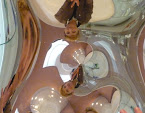
Gehry in Prague
Californian architect Frank Gehry and his Czech co-architect Vladimir Milunic designed and built the Dancing House (Tančící dům) between 1992 and 1996.
Soon after its conception it was dubbed 'Ginger and Fred', as it dances around the corner like the famous Hollywood movie stars Ginger Rogers and Fred Astaire.
It begins a row of buildings facing the Vltava River, on the Rasinovo Corner, opposite the bridge in Nove Mesto. To see images of the building works click here. My photos, taken in April, follow -


10.5.09

Steve Evans' annual map of what some poets are reading is gradually appearing on Third Factory. My own 'Attention Span' entries for 2008 are up on the web HERE
Subscribe to:
Posts (Atom)