24.4.09


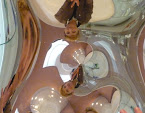
Minding mice at a crossroads: Mike, Jill, Phil, David, Louis, Annette, Maurice, Mary, Pam on the way to Brno

Trevor Joyce has put his photos (including the above) from last week's Czech Poetry Micro-Festival: Prague & Brno up on the web - to view the pics, that include photos from every reading, click here

Here is one of my photos of Trevor at the reading at Sklenena louka in Brno on April 16th :


The festival organiser, Louis Armand, has posted photos tracing the progression of the poetry events on Facebook here.

Louis Armand, after the last reading at Shakespeare & Sons, enjoying a glass of smooth South Australian red provided by Dianne Cornell, the Australian consul.

I'll be posting more on Prague, Kutná Hora and Brno soon.


19.4.09

ahoj from praha


            A person looks at a work of art called 'Relief' by Jan Fisar
               in the Czech National Gallery in Prague

                                                                        (Foto by Michael Farrell)


3.4.09

praha


I’m off to Prague to read poems and check out the Czechs, nashledanou, ahoj!


26.3.09

coming up in april


To see some of John Tranter's photos from the heady party at the opening of the avoiding myth & message exhibition last Monday night click here.


The intersection of Australia’s literary and contemporary art worlds is the subject of a new exhibition at the Museum of Contemporary Art, Sydney, opening this autumn.
avoiding myth & message: Australian artists and the literary world presents works by 28 contemporary Australian artists whose practice has been informed by literature.

later,
& like any poet
avoiding myth & message
to fake a flashy ode, consider
what model of Australia as a nation
could match the ocean, or get your desk
to resemble a beach/

The exhibition title is a line taken from John Forbes’ ‘On The Beach: A Bicentennial Poem’ (extracted above). Curated by Glenn Barkley and running from 7th April until 12th July 2009, avoiding myth & message takes up major themes within the Australian literary and visual traditions; themes which often overlap, such as landscape/interior, text and image, urban life, politics and the personal. Predominantly an MCA collection-based exhibition, it will include ephemera, publications and media-based works produced by artists and publishers from 1968 onwards.

It includes artists who have worked in an illustrative mode; artists who use words and texts within their work; and practitioners who adopt a more poetic, narrative-based approach inspired by literature’s ability to create a visual world based on language.
Works range from Vernon Ah Kee’s vinyl wall piece ‘Many lies’ (2004) which has been specially reconfigured for the exhibition cascading down an 11 metre wall, to Sandra Selig’s ‘Surface of Change’ (2007), a work created using pages from a children’s science book that have had words removed, leaving a new kind of poetry.

Destiny Deacon, Rosalie Gascoigne, Shaun Gladwell, Robert Macpherson, Noel McKenna, Ruark Lewis, Mike Parr, Imants Tillers, Jenny Watson and zinester Vanessa Berry are included.

Two works from the early 1970s by Mike Parr, ‘Wall Definition’ (1971) and the seminal conceptual artist’s book, ‘Black Box of Word Situations’ (1971–91), will be displayed as they were in Inhibodress when first exhibited in 1971.

Key collaborative book works and journals such as A Package Deal Assembly Book, Magic Sam, Surfers Paradise and Cocabola’s Funny Picture Book will be included in the exhibition, as well as individual writer and artists’ texts and publications, performance footage and works that trace the emergence of feminist, multicultural and gay voices within the literary and artistic scenes. This historical (1970s) section of the exhibition will also include a number of texts reproduced straight onto the wall, as well as works and publications by major figures within the Australian literary and artistic worlds, such as Rudi Krausmann, Tim Johnson, John Forbes, Ken Bolton, Tim Burns, TTO, John Tranter, Anna Couani, Vicki Viidikas, Pam Brown and Micky Allan.

MCA Public Programs are an integral part of the exhibition and many of the works have a performative or interactive component, with a number of poetry readings and talks scheduled to take place throughout the exhibition.


(I’ll post further information on the winter series of events co-ordinated by Morgan Smith of gleebooks closer to the dates in June and July.)


25.3.09

Congratulations Tim


The latest issue of overland includes some terrific poetry thanks to the energised selections (poems by Stuart Cooke, Trisha Pender, Chris Brown, Berndt Sellheim, Jessica Tyrell, Michelle Cahill and others) of the recently appointed (well, last year) poetry editor, Keri Glastonbury, plus there is the wonderful PRIZE WINNING (do italics still signify irony?) poem emoticon by Tim Wright. The prize was awarded to him last weekend in this funny looking building in St Kilda, Melbourne. It's a poetry centre.


23.3.09


Calling Laurie Duggan,
Give me back that copy of The Herd CD I gave you.
You you you traitor !!


12.3.09

Friday Night in Macao


I roll the dice - Contemporary Macao Poetry.
This anthology represents the first serious effort to collect Macao poetry for the English-language reader. A collection of poetry from and about Macao, it contains works by more than one hundred poets. Mainly translated from the Chinese, the volume also includes more than twenty Portuguese-language Macao poets as well as a number of local poets who have composed their poetry in English.


The Association of Stories in Macao (ASM) is a non-profit organisation dedicated to the promotion of writing and other artistic expression in and about Macao.'Promotion' includes a range of activities, from publishing (on-line and in print) and the organisation of events, such as book launchings, to poetry readings writing workshops and art exhibitions.
Click here to visit ASM's online journal Poetry Macao


9.3.09


I’ll be at the Malthouse Theatre in Melbourne this coming weekend to see Goodbye Vaudeville Charlie Mudd. But in Sydney I’d be going to Rae Desmond Jones’ book launch in Summer Hill.


click on the launch notice & other images to enlarge : click on bolder grey text for links

6.3.09

New Publications


Martin Edmond’s latest book The Supply Party is about the journeys of the 19th century German painter and scientist
Ludwig Becker
who died at Cooper’s Creek in Queensland
whilst participating in an expedition led by Robert Burke.
Click here for further info and an extract.


Adam Aitken’s new collection of poetry Eighth Habitation
will be launched by Marcelle Freiman at Gleebooks
in Sydney at 4pm on Sunday 5th April.


  Adam Aitken, Jane Zemiro & Martin Edmond, Breakfast at Blackheath, December 2008


1.3.09


Two years ago I read George Stanley’s selected poems from 1957 until 2000 - A Tall Serious Girl - and I became a fan of his writing.

His recent book, Vancouver : A Poem, in which he moves through urban Vancouver noting changes and seeming to talk to himself as he lets his reader eavesdrop, is just about the best book of poems I’ve read in ages.

There is more here than memory


Reading
Paterson on the bus, back & forth. Across the city. The 210.
A man & a city.

I am not a man & this is not my city.


In the bar, George Stanley instructs himself to

Write carelessly &
stop focusing


where a pal's maudlin griefy tears can be shed into Benedictine, where

The mind
edges away
from compassion - imagining
itself compassionate -
       leave it to the brain,
leave it to the big boy
to feel, even if it
makes big mistakes, it’s the big boy,
    it’s the one
must
(& I will not say die

I’m in the bar,
I’m happy but I’m lost whenever I come
to this point
of embarrassment as if to take over
knowledge that not yet
exists, is, write carelessly, write
    at the brink
(like a skateboarder I just saw on TV -
wake up! what time is it? -
crash into the oblong
bales of hay - set up -


He aims
not to be a man
to be a thought


This is the publicity description of the contents of the book :
The Lions [the twin mountain peaks visible from the city] bare of snow, crowded express buses, a giant red turning letter W. 'Vancouver: A Poem' is George Stanley's vision of the city where he lives, though he does not call it his own. Vancouver, the city, becomes Stanley's palimpsest: an overwritten manuscript on which the words of others are still faintly visible. Here the Food Floor's canned exotica, here the stores of Chinatown, here the Cobalt Hotel brimful of cheap beer and indifferent women.The poet travels through the urban landscape on foot and by public transit, observing the multifarious life around him, noting the at times abrupt changes in the built environment, and vestiges of its brief history. As he records his perceptions, the city enters his consciousness in unforeseen ways, imposing its categories and language. Skirting chestnuts on the sidewalk or reading William Carlos Williams's 'Paterson' on the Granville Bridge, the poet travels along the inlet, past the mountains, under the trees, interrogating the local world with his words.

Many of the first drafts of ‘Vancouver: A Poem’ were written in transit, on the bus or on SkyTrain. Others took their first shape in bars or restaurants. George Stanley has learned, he says, "more and more to let the poem write itself. Not to get in the way of the poem."

City of death, city of friends.


Even though it is not his city, George Stanley, originally from San Francisco, and now aged 75, has lived in Vancouver for over thirty years, long enough to have made friendships, acquaintances, to have taught many English classes, and to frequent a favourite local bar. He has passed by the same shops and buildings on bus rides and on foot, and he marks their various transitions. His poems observe tree roots lifting paving stones on the sidewalks, gold ink graffiti on the bus floor, the places where you can go to pee, like Pacific Centre Mall or McDonald's, and so on. When a local bar is closing to be reinvented as some other venue he calls it 'Reterritorialization'.


Seniors

Seniors know everything.
Correction: Each senior knows everything.
The others don’t want to hear about it.


26.2.09


You should click on this altered image to enlarge it
and scroll around in it if you want to read the text.
Altered from a photo of the Wooster Group by Paula Court.


22.2.09


Pride History Group is launching their latest booklet, Out and About: Sydney's Lesbian Social Scene 1960s-1980s. Based on oral history - interviews with women who were part of the scene - and including many historic photographs, this booklet explores the bars, social groups, dances and parties frequented by Sydney lesbians from the 1960s to the 1980s.

Saturday 28th February at 2pm
Fitzroy Room, Rex Centre,
58a Macleay St, Kings Cross
(entry off Fitzroy Gardens) near the fountain
phone for directions if you get lost : 0409446482

rsvp: phg@unwired.com.au by Thursday 26th February 2009


10.2.09


                       Some poems of mine are included in new editions of
                       Roger Humes’ Other Voices International Project
                       Anny Ballardini’s Poet's Corner - Fieralingue

                       And at last, and only three and a half months late,
                       Jacket Issue 36 is complete and ready to read.


                       cleaning up - from the fridge door -


3.2.09


It was the mid-fifties - I suppose it could have been Fantasia or something by Charlie Chaplin, films I saw around the same time, but I’ve always remembered (or thought) that the first film I ever saw was Jedda, in Toowoomba, Queensland, with my parents and, probably, although I can’t recall them being there, my older sister and brother. The cinema (was it ‘The Empire’ or ‘The Strand’?) was packed and so our seats were in the front stalls, close to what seemed an absolutely gigantic picture screen to a seven year old child. I was mesmerised and, terrified. I don’t think the system of rating films deemed suitable to audience age had yet been considered in Australia. Perhaps I’ve remembered it as my ‘first film’ because it was such an overwhelming and powerful film and it was in full brand-new technicolour too.

Urban Cinefile explains the film : “Determined to tell a story that could be told only in Australia by Australians, Charles Chauvel made Jedda, the first Australian feature film to use Aboriginal actors in the lead roles and the first to be filmed in colour.

Set in the Northern Territory, it is the tragic story of a young Aboriginal girl of the Arrente tribe, adopted by a white woman, Sarah McCann, as a surrogate for her own baby who has died. She names the baby Jedda after a wild bird and raises her as a white child, isolating her from Aboriginal contact.


But when Marbuck, an Aboriginal man seeking work arrives on the station, Jedda is fascinated by him. Marbuck takes the half-willing teenage girl as his captive, returning to his tribal lands, only to find he is rejected by his tribe for breaking the marriage traditions.


The two are hounded from the tribe and chased by the men from Jedda's home station, until Marbuck is driven mad, and falls over a cliff to his death, together with Jedda.”


Some years ago, the dvd release of Jedda in 2004, prompted journalist Paul Kalina to reassess the film in an article in The Age Newspaper.

Earlier this week the Australian national public radio broadcast a
re-engagement with Jedda
on the indigenous program AWAYE! with plenty of fascinating, insightful commentary about the making of the film and the thoughts, then and now, of the Aboriginal actors involved in the production and the prevailing societal attitudes to Aboriginal people around that time. Listening to the program, I remembered the powerful effect the film had on me as a very young girl, and I thought about how extraordinary change - tinged of course with a kind of informed and reflective plus ça change - can be, experientially, over half a century. Everything has changed - Jedda the film is almost a historical curiosity, but a formidable one.


31.1.09


                             (PB with apologies to Chester Gould)


24.1.09


In mid-December I read some poems into the telephone from my recently published book True Thoughts and was interviewed for Writers Radio by Cath Kenneally. To listen to the broadcast click here.

                                                Cath Kenneally


21.1.09


         Very best wishes to US friends from the deletions
         at this historic, momentous and wonderful time.


19.1.09


American Memories, Melbourne

(not quite after Hope Mirrlees)
I want a panorama

SOUTH - WEST
CACAO BLOOKER
GOG & MAGOG

green art deco bakelite in the national gallery

FITZROY (ST ASPEN SHIRAZ)
BRUNSWICK (SQUAWKING MAGPIE SAUVIGNON BLANC)
PARLIAMENTARY MUSEUM (HAZELGROVE PINOT NOIR)

creak chug creak chug creak chug under Princes Bridge on the Yarra

CASTLEMAINE ROCK

Greek woman tearing the gig posters from the lightpole
outside her son’s bar
Going down Madam ?

follow the commemorative brass plaques in the footpath
a golden mile must be almost two kilometres

ne rien faire walk slowly doing nothing
for approximately two hours

WARAKURNA ARTISTS at Alcaston Gallery in Fitzroy until Saturday

discover why Melbourne is called ‘marvellous’

a grey mouse running through green & purple wisteria vines

TIN BOX BUILDINGS
attached to creaking weatherboard cottages

the awful HARD art of the minimal
strikes here and
strikes again in Montréal, actually strikes TWICE in Montréal
at the Museum of Contemporary Art and at the Musée des Beaux Arts
too!

DUCRAY ICTYANE
créme émolliente hydratante blow wind blow
buy Magic Gloves at Dollarama

red wine and voodoo at RUBIS ROUGE

in the USA public toilets flush automatically which can be alarming
all announcers have Spanish accents
the L-A-N-G-U-A-G-E poetry is really realism
Ron Silliman’s VOG is Voice Over Guy, Voice Of God, Very Ordinary Glory
Vital Organs Grim …

on the SILVER STAR 91
from Philadelphia Pennysylvania to Richmond Virginia
(Dixie Hummingbirds, Cab Calloway, Ruth Brown, Amos Milburn)

the suitcase keys
are in
the alternative medicine pill bottle

GREAT DISMAL SWAMP

Henry ‘Box’ Brown
mailed himself to freedom
in a big box labelled ‘Dry Goods’ - from Virginia to Philadelphia in 1849

on the NORTHEAST REGIONAL 94
from Richmond Virginia to Washington District Columbia
(Elizabeth Cotten, Duke Ellington, Marvin Gaye)

innumerable Stars & Stripes innumerable

Famous American Female Poet :
‘What you might need to know is that you might not make it
But if you do, you might have needed an astrolabe
or a two-bit smile or smirk, this is a style
that could get you a cup of coffee’

AMERICAN coffee ??
old worms in the woodwork
old hooks on the hat rack
old bottomless cups depleted

TIPPING drives me crazy -
quoted price
+Value Added Tax
+15%
bring a pocket calculator

As Portentous As The Opening Chords Of A Big Bob Dylan Ballad
the prescience of the dead


Yours truly, Your paranormal host,
Adelaide


hooray at last here’s the panorama coming up now

discover all the charms of ELEGANT and CONTEMPORARY
melbourne

cross the west gate bridge for AMAZING city views
observe the yarra river's BUSTLING ACTIVITY
see queen victoria market, fitzroy gardens
and albert park, home to the australian formula one grand prix.
visit the HISTORIC shrine of remembrance
stroll along southbank's waterfront precinct

this city has it ALL - discover it for yourself

pour boire, merci, thank you, tip

taxi to lax

KOONS RUSCHA CHEECH the CHICANO
JaMaiCan LeMoNaDe woo you never know
HeY HeY VLaMinCK !
Maurice Vlaminck’s portrait in oilpaint of Guillaume Apollinaire

white women smiling into the air
Michael Jackson and his monkey

NO POETRY MEETING TODAY - EVERYONE IS WORKING

greasy screen at the mex internet café grill
too dangerous
to walk south
down the SAN DIEGO freeway

Almost Completely Finished With Pop Art Finally
call the paramedics


The quote from the ‘Famous American Female Poet’
is from Above The Leaders by Alice Notley (Veer Books, 2008)


17.1.09


Another year has begun and it's definitely time to begin it, so I've been sorting through some box files and folders and throwing out old clippings, photocopies, maps, pictures, postcards. Allow me a little personal indulgence - here, from the piles of files is a tiny sample from hundreds of bits and pieces. Remember, if you click on the images you can enlarge them. I'll start with a set of the card game 'Happy Families' I made, with my mother Jean, when I was seven years old. You can view the entire pack here. Clunkily cut cardboard, dribbly watercolour - I wasn't anywhere close to being even a 'budding' artist but there were hours of fun up ahead playing cards.


Little images or notes found or clipped or kept, like one of my father's military notebooks, or a scrap of paper, a ticket, a jigsaw piece, a label popped into a pocket, placed in a notebook and later saved in a box file :


                    click any of the images (except Her Grumpy Majesty) to enlarge them


16.1.09

Now now now


The Now now festival is on again this weekend.
For further information and tickets to events click here


12.1.09


                                                   Cover illustration by Julia Wolfson.

Ekleksographia is an independent international poetry magazine edited, produced and published by Jesse Glass, Daniel Sendecki and a revolving panel of editors. The publication revolves completely around their efforts and therefore maintains a somewhat irregular publication schedule, averaging about 2 issues a year. Ekleksographia employs a 'revolving editor' system—the magazine retains a panel of editors, each of which edits one issue every so often.

Ekleksographia is published as an Ahadada Books cooperative publication. Editors and contributors are asked actively to contribute both their talents and their time to the publication.

Ekleksographia is an exercise in asymmetrical publishing, and is a shoe (or even two!) thrown at the spotlit shrug and yawn.

This issue was curated by Jane Joritz-Nakagawa. Jane's third book of poems, EXHIBIT C, has been published by Ahadada (autumn, 2008). Her other poetry books are Skin Museum (2006) and Aquiline (2007).

Contributors to Volume 1:
Frances Presley | Cyril Wong | Pam Brown | Michael Rothenberg
Cynthia Hogue | Joel Chace | Elisabeth Frost
Takako Arai (trans. Jeffrey Angles) | Alan Botsford | Harriet Tarlo
Samuel Day Wharton | Michael Crake
Yoko Danno | Kyong Mi Park (trans. Lianna Kushi) | Paul Hoover
Philip Rowland | William Allegrezza | Jane Joritz-Nakagawa


7.1.09


I am reading Loiterature, happily not an obsessively-linear book, by the only Australian member of OuLiPo, Ross Chambers, who is currently the Marvin Felheim Distinguished University Professor of French and Comparative Literature at the University of Michigan and is a Visiting Professor at Louisiana State University.


The cover image of ‘Loiterature’ is a detail from a photograph by Montague Glover


                         Montague Glover’s photograph

Loiterature's Chapter I   Divided Attentions (On Being Dilatory) begins:

I’ve been giving up caffeine for years now, but a caffé latte steams at my elbow. Midsummer:

    Wet heat drifts through the afternoon
    like a campus dog, a fraternity ghost
    waiting to stay home from football games
    The arches are empty clear to the sky

These verses might have been written (or composed, or generated) only a few yards from where I sit, at the intersection of N. University and S. State in Ann Arbor, the suture point (in my personal myth of the city) where the campus meets the town. No campus dogs in evidence (expensive animals on leashes don’t qualify). Times change. When Frank O’Hara came to Ann Arbor in 1950 he was amused by the Midwestern candor of the cafeteria signs that read, bluntly, FOOD; today they’re more likely to read cappuccino, and it’s hard to find a cafeteria:

              (la forme d’une ville
  Change plus vite, hélas! que le coeur d’un mortel).

Sitting lazily at this much frequented intersection, I think about intersections and I think about belatedness, my regret for an Ann Arbor I never knew (and wouldn’t have liked), the stab of Baudelaire’s midline exclamation point at “hélas!”, the image of abstention - better still, of anticipated abstention - in “waiting to stay home from football games.” Being belated, one foot in 1950, the other in the 1990s, is (like abstaining and anticipating) a form of divided attention, the “distracted” attention Benjamin thought characteristic of modernity (
was it Benjamin? I must remember to look it up). One foot in campus, one in town; one in 1950, one in 1994.....

Loiterature's back cover notes give a pretty good summary of the contents :
The fabric of the western literary tradition is not always predictable. In one wayward strand, waywardness itself is at work, delay becomes almost predictable, triviality is auspicious, and failure is cheerfully admired. This is loiterature. Loiterature is the first book to identify this strand, to follow its path through major works and genres, and to evaluate its literary significance.

By offering subtle resistance to the laws of "good social order," loiterly literature blurs the distinctions between innocent pleasure and harmless relaxation on the one hand, and not-so-innocent intent on the other. The result is covert social criticism that casts doubt on the values good citizens hold dear—values like discipline, organization, productivity, and, above all, work. It levels this criticism, however, under the guise of innocent wit or harmless entertainment. Loiterature distracts attention the way a street conjurer diverts us with his sleight of hand.If the pleasurable has critical potential, may not one of the functions of the critical be to produce pleasure? The ability to digress, Ross Chambers suggests, is at the heart of both, and loiterature’s digressive waywardness offers something to ponder for critics of culture as well as lovers of literature.

Read Laurence Porter’s review and a ‘preview’ of the book here

Books by Ross Chambers include The Writing of Melancholy, Facing It : AIDS Diaries and the Death of the Author, and Room for Maneuver.