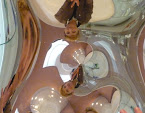
We went to the lively and crowded Haldon Street Festival in Lakemba, Sydney today. You can see some more photos of
this annual multi-cultural celebration here.
We went to the lively and crowded Haldon Street Festival in Lakemba, Sydney today. You can see some more photos of
this annual multi-cultural celebration here.

You are invited to celebrate the Sydney launch of
Sputnik's Cousin
Bonny Cassidy, Ross Gibson and I will be praising this incredibly unpredictable book by Melbourne-based Kent MacCarter who has published just about every contemporary and past Australian poet in Cordite Poetry Review.
Gleebooks, Thursday August 7th 6 for 6.30pm
For event information, address etc follow this link
Everyone welcome
by poet and Cordite Poetry Review editor, Kent MacCarter
Hope to see you there

A Rainbow Reader is a work of creative non-fiction which looks at colour from the personal perspective of Tessa Laird, an artist, writer and lecturer based in New Zealand.
'In 2009, Tessa Laird began investigating the (r)evolutionary power of colour, from a personal, and political, transformative angle. A Rainbow Reader is the result of that study. Consisting of six chapters, one on each spectral hue, colour becomes a catalyst for speculative writing encompassing art history, literary criticism, personal anecdote, philosophy and anthropology.
Each chapter of A Rainbow Reader is bound in the appropriately coloured card; together, the six chapters form a rainbow spine and operate as a kind of edition-based artwork, a veritable rainbow on your bookshelf.' (notes from the publisher)

A Rainbow Reader is published by Auckland-based art books press Clouds. Further information - here.

The Dark Horsey Form Guide, Archive & Punter's Companion
METHOD FOR FORM'S SAKE
Sarah crowEST — A Serious Of Objects — Australian Experimental Art Foundation, May 22nd—June 28th
Download pdf here.
Critical writing by Ken Bolton
Sam Howie — Survey — and Return Threshold—Patrick Hartigan, Michelle Nikou, Marcin Kobylecki, Charlie Sofo—Fontanelle, May 18th—June 8th
Peter Atkins — Silence — and James Guerts—Topography Of Water—Greenaway Art Gallery, May 28th—June 22nd
Juz Kitson — Still Life: Sleep of non-being — Greenaway Art Gallery, June 25th—July 25th
Joe Felber — Kontaktraum : Auslander (space of contact—foreigner)— Contemporary Art Centre of South Australia, June 13th—July 13th
Earlier Form Guides available here

It's impossible to synthesise or to summarise the extraordinary poetic poeises of the last couple of weeks. It began with the CONTEMPORARY WOMEN’S WRITING AND ENVIRONMENTS conference at the State Library in Melbourne, Victoria from the 3rd until 5th July comprising dozens of brilliant contributions and five great keynote speakers Chris Kraus, Lyn Hejinian, Alexis Wright, Kate Rigby & Deborah Bird Rose.
See the entire program here.


Immediately following the Melbourne conference, EXPERIMENTAL, convened by Associate Professor Kate Lilley, Director of Creative Writing at the English Department, University of Sydney, began on Sunday July 6th with a mistress class by Carla Harryman and continued the following morning with an official program that can be viewed here.
The information -
This exciting 2 day symposium on experimental writing and poetics features Carla Harryman, Lyn Hejinian and Barrett Watten, three of the most significant and influential architects of the movement which has come to be known as Language writing, live and in person. The important English poet-critic, John Wilkinson, will also give a keynote reading. A fantastic lineup of participants from around Australia includes: Pam Brown, Andy Carruthers, Kate Fagan, Toby Fitch, Anna Gibbs, Ross Gibson, Melissa Hardie, Luke Harley, Martin Harrison, Fiona Hile, Eddie Hopely, Ella O’Keefe, Astrid Lorange, Kate Lilley, Philip Mead, Peter Minter, Sam Moginie, Gig Ryan, Chris Rudge, Ann Vickery, Corey Wakeling and Jess Wilkinson.
The Symposium will end with a celebratory reading at Sappho Books, 51 Glebe Point Rd, Sydney, July 8, 7pm.
On Wednesday 9th July Kate Fagan, poet and Lecturer in Literary Studies at the Writing & Society Research Centre,University of Western Sydney hosted a reading and conversation with Lyn Hejinian. Lyn read 'Lola' a chapbook segment from her book Saga/ Circus and a selection from her latest book The Book of a Thousand Eyes. After morning tea, Lyn Hejinian and Kate Fagan conducted a fascinating conversation with participation from the audience.
& here's Ampersandy's photo of me talking with blurry Sam Moginie & Ella O'Keefe at the same event:
Join us for a pre-symposium reading at Gleebooks on June 30th, 6 for 6.30pm with Pam Brown, John Tranter and John Wilkinson.

L t R : Karen Sonnenschein, Pam Brown, Nola Farman, Kate Lilley, Lyn Hejinian
& Carla Harryman at Sappho's (foto by Luke Harley)

Kate Lilley & Barrett Watten at Sappho's (foto by Luke Harley)

Lyn Hejinian heard by Astrid Lorange, University of Western Sydney
There are more photos of this event here and here's my photo of one member of the audience, poet and recent PhD recipient, Andy (Ampersandy) Carruthers :


In 1962, at the age of 19, Sue Ford was one of only two women enrolled in the photography course at the Royal Melbourne Institute of Technology (RMIT). She continued making photographic work throughout her life. Sue and I became good friends in the late seventies. Sadly, Sue died in 2009 (noted here - obituaries can be found here and here.) Now the National Gallery of Victoria is exhibiting a retrospective of her work at the Ian Potter Centre in Melbourne. It runs until August 24th. You can find information here and here. Read two reviews here and here.
the deletions presents a sample of photos from her life and work
(as usual, click on the images to enlarge them):

Reel Women, a feminist filmmaking group, Victoria, 1981 (Sue is at the rear of the ute)

Ben Ford (who has helped curate the NGV exhibition) & his mother Sue in 1980
photo by Micky Allan

Micky Allan, 1975, photo by Sue Ford

Shadow Portraits by Sue Ford, National Gallery of Victoria, 1994

Discussions Between Bob Hawke and Galarrwuy Yunupingu
(Galwarrway is painted with his father’s body design from the Gumatj clan)
by Sue Ford 1988
(courtesy the Estate of Sue Ford and Arc One Gallery, Melbourne)

Sue Ford -Self-Portrait 2004 (courtesy the Estate of Sue Ford
and Arc One Gallery, Melbourne)

Snapshot - Sue & crazy-smiling Pam, Sydney 1982

click on the gallery invitation to enlarge it

Reading Michele Leggott's Heartland
(Auckland University Press, 2014)
Rachel Blau DuPlessis
Michele Leggott's essay on blindness and insight (delivered in Canberra in November 2013), "Small Stories from Two Decades," is both specifically moving and ontologically lucid. It tracks what one might call her "influences" - particularly the poetry of Robin Hyde and of Alan Brunton (as well as the filmmaking of Sally Rodwell, Brunton's wife). Both New Zealand poets have been subjects of Leggott's scholarly contributions to literary study as well as key poetic sources for her. One central topic of her essay is: What happens when the sighted poet goes blind? Not so much an essay about the major, unsettling physical, technological and familial adjustments nor a confessional essay displaying feelings on the surface of her reactions, this essay is rather like an in-depth sounding, in vignettes, of the rhythms and perceptions that have collected for her around the works and lives of these other two poets and that arrive in her own "heartland." This final moment of the essay contains a realization - an epiphany, in fact - that even the magnification of the computer screen is now no longer enough for the progressive failures of retinitis pigmentosa. In addition, that screen and that technology are now taxing and debilitating to her. She is, at that moment, truly blind. And Leggott says, with great spiritual poise and equanimity: "[My eyes] have done their work and I am thankful for it. Without them I would not have deep reservoirs of visual memory. Let us go on into the dark and not be afraid." This fearless and touching insight also saturates the book Heartland, but it is not the only feature of this multi-ply work of synthesis and perception - personal, cultural, historical.
Heartland, the title, perhaps a superficially sentimental word (the land of the heart, the center of a nation state), should fool no one - the book is a tensile work that works with three interlocking themes: travel and place, family history including - appropriately for the anniversary year 2014 - WWI, and blindness. In each thematic zone, the compound word heart-land metamorphoses, torques, pulses. As Leggott braids these strands together with skill, research, poetic subtlety and a spiritual inhabitation, the reader might find that this 16-line extended sonnet "degli angeli" (p. 28) offers one "topic sentence":
I saw my angels they were beautiful
This poem shows Leggott's characteristic "streaming" sound, a distinctive way of suturing materials without punctuation (which is possibly an aural and visual encumbrance). The lines create a filmic experience within the mind-that-makes-language. This poetic tactic constructs an airy, yet dense texture in the poems, over-passing phrasal and sentence-based line breaks, and it proposes constant rushes of apprehension - meaning both alertness and shadows of worry. Very intense and yet also quite sustained across poems, this line is like the running of time in space: "dazzling in its troubadour take / on real life" (p. 9). Leggott tells us, as a kind of poetics but also ontological insight, that she has "changed hands" - first "alpha" held her, but now "omega" does (pp. 24 and 25) - first she worked from actual vision, and now from sound and the visionary gifts of memory and reconstruction.
Key words in "degli angeli" (and, in the heightened angelic context, possibly surprising ones) are "disaster" and "engines," but also the sheer question of movement (moving together? moving apart? "complete"? "not defined"?) and the question of a specific wind-swept headland geography. This material joins with traveling, and a with singular dark illumination given these angelic debates about outcomes, because those inevitably frame precariousness. These questions and ambiguities are all tokens redeemed in the book itself. The place names as well as the peoples' names work so that people become places and places become people - it is odd, but one actual effect of a settler society (both Maori and Europeans are settlers to New Zealand). In these opening poems, the light-filled, evocative spaces and the litany (of Maori and English names, of place names and person-names), emerge in a sonic tracking shot across the New Zealand landscape, and in this sound of the place, a remarkable book takes shape: one moving, subtle and skilled, authentic by being demonstrably researched - but also uncannily inhabited by spirit.
Motion is one motif, and it is quite "moving" as a motif, because of the insistent record of hopes and losses that it tracks. There is the motion of traveling - back and forth across oceans, up and down the difficult coastline, for the settlers are often found in motion - NZ to Australia, then to Europe and the First World War; NZ to Canada; NZ to England. And maybe back - some people chose to go back to their home on the islands, but some don't, and some have no choice - as the war section relates. Immigration/ emigration are constant. Distance itself is a constant loss, often leading to elegy, as in the poem where the father sees the poet off to Canada - the very last time she saw him ("harbour lights," p. 63). Then there is motion up and down the coast, including the family story in the book's final section that narrates a complex, difficult family history with, at the very end, Leggott's great-grandmother retrieving the body of her abusive husband and bringing it home for burial. This narration (using as much as one knows or can find of stories with many lacunae) assembles fragments of her own family "heartland"--one that (as all of ours) might have as many broken hearts as whole ones (as in the angelic "complete"? "not defined"?). The ways she treats emotional losses and incapacities (as in some of the family poems) are tactful and full of insight. ("the doll the chest the swords the delicate carving / he understood the wife and children he did not" [p. 62]). The motif of family stories - hope and loss - intersects with traveling (back and forth) - so that those stories are infused with the motif of simply traveling through life, as openly as possible, with all the risk and losses that "voyage" may entail.
These historical stories intersect with Leggott's own voyaging. She includes a very neat section called Many Hands about going to Australia to visit friends - "Pam" and "Jane" among them, but also finding "Karen" - the prosthetic voice on the GPS [global positioning system], a voice also found on Leggott's computer to read to her, and Lola Ridge (a peripatetic poet). Ridge herself might exemplify that theme of emigration and motion: born in Dublin, immigrated to New Zealand as a child; then to Australia, and then to San Francisco, dying in New York City in 1941. Written with great fondness and charm, this "Tasman" sequence marks the differences and bonds among those two island countries (Australia and New Zealand).
Second, as a motif in the book, there is a sense of disaster just on the edge (and sometimes even not so far away), with the uncommon bravery demanded by the ordinary lives and fates (and sometimes deaths) of ordinary people. This includes an astonishing recreation of the losses of WWI - the human disaster, in the sequence about the brothers. This work is a striking transformation of research and family materials into humane insight. In this regard, death is sometimes intermixed with disaster, as in the three poems about dogs, who do have a place in our human heart-land. This - at first seemingly simply occasional elegiacs - culminates in the jaw-dropping poem about the arrival of Olive, Leggott's actual guide dog, intersecting precisely, to the very day (a day whose events actually impeded the long-awaited arrival) - with the Pike River Coal Mine disaster in New Zealand in November 2010. This was a quadruple explosion in which miners - "the twenty-nine" - were buried alive or killed by methane, and it culminated (after the usual recriminations, investigations, and discoveries of unenforced regulations and inspections) in the resignation of the Minister for Labor (2012) and virtually no compensation for the families of the dead. In her poem, Leggott tactfully fuses one dark with another in a pitch-perfect fashion, tracking how, amid the horrible news, one yearns to keep hope alive but eventually all were faced with defining losses. The men could not be rescued. The dog eventually arrived, marking a new stage in the management of blindness.
Third, in Heartland as a whole, there is the motif of the dark, coping with the dark, being in the dark, giving up the light slowly and writing a recurrent elegy for that fact. The matching sequence poems that deal with this material "experiments (our life together)" and "talking to the sky" (pp. 74-77) are major work. They are stunning and restrained poems about blindness. Both are in 5 line sections--a subtitle and response. Here is one example:
here I give up my hand in front of my face
But in all cases, the theme of - the charge of blindness - is accepted and managed with tact, fortitude, and sprezzatura. It is only one part of the general sense of precariousness that is at the heart of Heartland, and always at all moments addressed with tact and fortitude. This is a humane book because of its clarity about human fortitude. Heartland is a book of poetic elegance and tremendous generosity of spirit.
beyond compare flags snapping above the headland
combed blond by wind they were sitting
each with disaster in a small pocket and they were
so beautiful in their resistance to the idea
of letting it fall into the world they were meeting
in a room with light powered by small engines
perfect examples of resonance and the distribution
of energy to this evolving flute that tapering cup
in the hand of something like god or the sound
of wind across hillsides how to say it they were
complete they were not defined they were still
and they were moving each moment closer
to each other and further away I saw them they were
beautiful they were the winds of heaven
in a small cup unbreakable and looking at me
she was there yesterday but now she is gone
lifted into the plane of hand-coloured lace
her smile her green eyes her lily of the valley
bouquet the first day of spring and forever
Rachel Blau DuPlessis' latest book is called Interstices, published in the US by Subpress in early 2014. You can find further information about it here and more about her life & work on her website here.
A Poetry Reading

on the occasion of two visiting poets -
Fiona Hile is a poet, critical writer and scholar. She has published a chapbook called The Family Idiot with Vagabond Press and, more recently, her first collection of poems, Novelties, was published by Hunter.
Kate Lilley is a poet, editor, scholar and academic at Sydney University. Her collections of poetry are Versary (Salt) and Ladylike (UWA Press). She has also published The Blazing World - a book on 17th century aristocrat and writer Margaret Cavendish, and a chapbook with Vagabond Press called Round Vienna.
Louis Armand is a poet, novelist, visual artist, philosopher and academic at Charles University in Prague. He is the publisher of Litteraria Pragensia and founding editor of VLAK magazine. His latest book, published by Vagabond Press, Indirect Objects, will be launched in Sydney on Saturday 24th May (see below for details).
Pam Brown is a poet, editor and reviewer. She has published many books including two chapbooks with Vagabond Press - Drifting Topoi and Let's Get Lost (with cohorts Ken Bolton & Laurie Duggan). In 2013 her latest poetry collection, Home by Dark, was published by Shearsman Books.
at
on
everyone welcome
books will be available for sale for cash only
for directions search 'Woolley Building" on the campus map
Fiona Hile : Kate Lilley
Louis Armand : Pam Brown
Fiona Hile from Melbourne & Louis Armand from Prague
The Common Room,
Upstairs in The Woolley Building
Science Road
University of Sydney
Wednesday 21st May
at 5 for 5.30pm
Booklaunch - Louis Armand's Indirect Objects

Vagabond Press is proud to announce
on Saturday 24th May
info & directions here
"Louis Armand is the international conduit for much of the dialogue that’s developing today. He is an internationalist, an innovator … he’s genre busting & on an ‘open’ passport."
the release of Louis Armand's Indirect Objects
to be launched by longtime Vagabond collaborator Pam Brown
during the Sydney Writers' Festival.
at 3pm
at the Sydney Dance Lounge
Pier 4/5 Hickson Road, Walsh Bay
- John Kinsella
To order a copy - click here.
THE LEE MARVIN READINGS

at
every Tuesday of the month
1. JUNE 3rd • LEE MARVIN in
2. JUNE 10th • LEE MARVIN in
3. JUNE 17th • LEE MARVIN in
4. JUNE 24th • LEE MARVIN in
Dark Horsey Bookshop
Australian Experimental Art Foundation
Lion Arts Centre, North Tce [West End]
Adelaide
South Australia
at 7:30pm for an 8pm start
for $5
ON BEING & NOTHINGNESS
Andrew Peek • Jill Jones
Heather Taylor Johnson • Stefan Laszczuk
ON BEING JOHN MALKOWICZ
Pam Brown • Ken Bolton
Cath Kenneally • Claire Roberts
ON BEING ONDINE
Astrid Lorange • Tom Sullivan
David Mortimer • Naomi Horridge
ON BEING, REALLY, STONKERED, K-BLAMMO, OUT-TO-LUNCH
Peter Goldsworthy • Angela Meyer
Shannon Burns • Caitlyn Lesiuk
The strange thing is, or is it a 'strange thing'? Is it a normal path-to-progress thing or whatever a usual expectation might be called? The thing is that, fifty years ago, there were three plump school exercise books filled with mostly dreadful adolescent poetry, with no Beat nor NYNY genius nor Russian poet within cooee for a couple more years. The exercise books were each called 'THING' - THING I, THING II and THING III. This third 'THING' has recently resurfaced and reminds me that nearly four decades later - decades of poetry writing - my book of poems called 'Text thing' was published by Little Esther Books. In 2002. I can only wonder. Or not.
The grubby beaten up THING III with its cliched maxims in teenage handwriting looks like this :
Maybe I can only note the small coincidence.

'Text thing' looks like this :

(for Rachel Loden)
Rachel Loden commented :

With trepidation, Rachel, I'll give you a glimpse of the very tentative, inchoate and pretty terrible poems I wrote day after day as a high school student in the subtropical heat of Brisbane, Queensland in 1965. These three fragments were from February. I wonder what was so great about 'Wednesday' and I can't remember who the 'you' I was longing for was. I think I'd read too much English Victorian poetry, or the capitals of Carlyle, for my own good. And as for the Tree Gods and Goddesses - who knows? The handwriting is really strange to me now too - apart from the capitals there are those weird angular 'g's and 'f's and 'y's. Anyway here goes - juvenilia is us - hope I don't regret it -


ka mate ka ora
a new zealand journal of poetry and poetics

Issue 13, published in March, has some material from 'Poetry as Social Action', a symposium held at the University of Auckland
To read it and link to further documentation of the event
And then read Susan Schultz's response to Christopher Parr here.
at the end of September, 2013
visit the journal here
A Poetry Reading
on the occasion of two visiting poets -
at
on
everyone welcome
for directions search 'Woolley Building" on the campus map
Fiona Hile : Kate Lilley
Louis Armand : Pam Brown
Fiona Hile from Melbourne & Louis Armand from Prague
The Common Room,
Upstairs in The Woolley Building
Science Road
University of Sydney
Wednesday 21st May
5 for 5.30pm
'Poetry & the Trace' brought together a range of national and international poets and critics to discuss poetic impulse. The conference celebrated the many ways which poetry as a genre can question and drive our human experience. Focus was given to what Derrida described as the trace – be it of memory, desire, the past and the goal of ethics.
The conference inspired ongoing dialogues between poetries from different regions. It also encouraged debate about the role of contemporary poetries and their histories both within Australian culture and beyond. You can find the entire program here.
Papers from the wonderful conference, Poetry & the Trace convened by Ann Vickery, Rose Lucas & John Hawke in Melbourne in July 2008.

not every participant is included but many are -
Ann Vickery : Rachel Blau DuPlessis : Lionel Fogarty
John Kinsella : Kate Fagan : Patrick Jones : Bonny Cassidy
Keri Glastonbury : Jill Jones : Thomas Ford : Susan Stewart
Simon West : Jessica Wilkinson : Melissa Boyle
Elizabeth Wilson : Bernadette Brennan : Kate Lilley
John Tranter : Josh Mei-Ling Dubrau : Hazel Smith
Sally Evans : Michael Farrell : Melissa Hardie : Emily Bitto
Sue Gillett : Joy Wallace : Kim Cheng Boey
Anne Collett : David McCooey : Emily Finlay
Nina Philadelphoff-Puren
This is a terrific record and a great resource
with an erudite introduction by Ann Vickery.
For further information & to buy a copy
visit the publisher Puncher & Wattmann
3chaps2014.JPG)
In today's mail - three of the twenty-eight booklets published by Semiotext(e) on the occasion of the Whitney Museum of American Art Biennial currently showing in New York City. Semiotext(e) has also organised some readings for the event. Here's what Peter Schjeldahl thinks of the exhibition in general - click.
Société Jamais-Jamais presents Alibis
Now available. Order a copy here.
Here's an extract:
poems in English and French by Pam Brown
translated by Jane Zemiro

Click on the cover to enlarge.
Scenes

what’s graspable
on the starless night
of the blackout
as the gleaming cars
snake cautiously
up around
that hillside curve
is the way
the absence of street light
suggests the past -
not a past
I ever knew,
but one I make up, tonight

a boy slides through it
on a silver scooter,
coming back
from synagogue,
curly tails
dangling beneath
an embroidered yarmulke
perched like a lid
to imagination’s
reckless feats
or dimmer prospects -
sets of fraying notebooks
filled with scripture

	    *
over the road
two very stoned spectres
can’t figure out
how to turn off
the one
working headlight
on their old
silver BMW
so they leave it on
& hurry off
on foot,
jerkily,
on pills probably,
fags attached
to lower lips,
flat battery
a portent

	    *

an intense white light
shines down
through folding greys
on the isolated city -
it transforms
to a plastic model,
to a distant maquette,
like toys on my horizon

that white plastic bag
has been drifting
from the gutter
to the road
for three days,
when the rainwater
carries it off
to the Tasman Sea
I think I’ll miss it

*  *  *  *  *  *  *

Scènes

ce qu'on peut saisir
par cette nuit sans étoiles
alors que des voitures reluisantes
serpentent prudemment
le long d'un virage de la colline
c'est la façon
dont l'absence d'éclairage des rues
évoque le passé -
pas un passé que
j'aie jamais connu
mais celui que j'invente, ce soir

un garçon glisse dans la rue
sur un scooter en argent,
il revient
de la synagogue,
des frisettes
qui pendent sous son yarmulke brodé
perché comme un couvercle
sur des exploits téméraires
de l'imagination
ou peut-être même -
une série de cahiers effilochés
remplis de textes sacrés

    *

de l'autre côté de la route
deux spectres complètement défoncés
n'arrivent pas à comprendre
comment éteindre
le seul phare
qui fonctionne encore
de leur vieille BMW argentée
alors ils y renoncent et se sauvent
à pied,
par à-coups,
bourrés de médicaments sans doute
une clope attachée
à la lèvre inférieure,
la batterie plate
un présage

    *

une lumière blanche, intense
perce
les plis de gris
couvrant et isolant la cité -
elle se transforme
devient un modèle en plastique,
une maquette lointaine,
comme des jouets sur mon horizon

ce sac blanc en plastique
vole à la dérive
du caniveau
jusqu'à la route
depuis trois jours,
la pluie
finira par l'emporter
dans la mer de Tasman
je crois qu'il va me manquer

I began to read the political aesthetic work of Esther Leslie with Synthetic Worlds : Nature, Art and the Chemical Industry which considers the alliance between chemistry and art, going from the late eighteenth century to the period immediately following the Second World War. It's an absorbing book that opens new insights into the place of the material object and the significance of the natural, the organic, the inorganic and the synthesized in a poetics of science. I'm currently reading Derelicts : Thought Worms from the Wreckage.
Philosophy and art with the imagination to actually change the world: this is the unfinished dream of history and the heart of the revolutionary modernism of the early 20th century, which globalised war and exploitation managed indefinitely to defer. Esther Leslie reopens the cold case on filmmakers, artists, thinkers and other animals, exiled or otherwise Disneyfied, and finds still-warm fertile ground for a wild future as yet unfulfilled. From ideal homes with traces erased to utopian rivers drawn back to their source, the alienated subject of history discerns its rightful place in the present tense, with no room for buts or half-measures. The derelicts of history find new life beyond commodified thought: would that the same could be said for all their readers.
Further information and publication details - click here
Esther Leslie at AMM#8: Derelicts - Thought Worms from the Wreckage from Jimbo on Vimeo.
Esther Leslie on Walter Benjamin - click here
The book includes Kim Hyesoon's short statement on Korean poetry and her own writing, as well two interviews. In one excerpt from an interview published here (from the summer 2012 edition of Munyejungang) Kim Hyesoon explains the background to her tremendously powerful poem 'I'm OK, I'm Pig!'. A brief summary is that there was an outbreak of foot and mouth disease in South Korea in 2011 and three million pigs (and almost every cow in the country) were buried, whether diseased or not, and many were thrown into pits and buried alive.
The poem is an extraordinary response to one form of contemporary barbarism.
For information visit the publisher's site here.
A new collection of poetry by Kim Hyesoon, translated from Korean by Don Mee Choi,
has been published by Action Books.
For information on the translator, Don Mee Choi, click here.
For my brief essay on some of Kim Hyesoon's earlier work click here.


Avant Gaga # 9
Poetry Reading at Sappho's
51 Glebe Point Road, Glebe, Sydney
Tuesday 11th February at 7pm
Aden Rolfe, Astrid Lorange
Ross Gibson, Pam Brown
Click below to enlarge:

For further information about Sappho's visit this link.