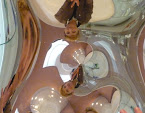
In today's mail - three of the twenty-eight booklets published by Semiotext(e) on the occasion of the Whitney Museum of American Art Biennial currently showing in New York City. Semiotext(e) has also organised some readings for the event. Here's what Peter Schjeldahl thinks of the exhibition in general - click.
31.3.14
26.3.14
Société Jamais-Jamais presents Alibis
Now available. Order a copy here.
Here's an extract:
poems in English and French by Pam Brown
translated by Jane Zemiro
Click on the cover to enlarge.
Scenes
what’s graspable
on the starless night
of the blackout
as the gleaming cars
snake cautiously
up around
that hillside curve
is the way
the absence of street light
suggests the past -
not a past
I ever knew,
but one I make up, tonight
a boy slides through it
on a silver scooter,
coming back
from synagogue,
curly tails
dangling beneath
an embroidered yarmulke
perched like a lid
to imagination’s
reckless feats
or dimmer prospects -
sets of fraying notebooks
filled with scripture
*
over the road
two very stoned spectres
can’t figure out
how to turn off
the one
working headlight
on their old
silver BMW
so they leave it on
& hurry off
on foot,
jerkily,
on pills probably,
fags attached
to lower lips,
flat battery
a portent
*
an intense white light
shines down
through folding greys
on the isolated city -
it transforms
to a plastic model,
to a distant maquette,
like toys on my horizon
that white plastic bag
has been drifting
from the gutter
to the road
for three days,
when the rainwater
carries it off
to the Tasman Sea
I think I’ll miss it
* * * * * * *
Scènes
ce qu'on peut saisir
par cette nuit sans étoiles
alors que des voitures reluisantes
serpentent prudemment
le long d'un virage de la colline
c'est la façon
dont l'absence d'éclairage des rues
évoque le passé -
pas un passé que
j'aie jamais connu
mais celui que j'invente, ce soir
un garçon glisse dans la rue
sur un scooter en argent,
il revient
de la synagogue,
des frisettes
qui pendent sous son yarmulke brodé
perché comme un couvercle
sur des exploits téméraires
de l'imagination
ou peut-être même -
une série de cahiers effilochés
remplis de textes sacrés
*
de l'autre côté de la route
deux spectres complètement défoncés
n'arrivent pas à comprendre
comment éteindre
le seul phare
qui fonctionne encore
de leur vieille BMW argentée
alors ils y renoncent et se sauvent
à pied,
par à-coups,
bourrés de médicaments sans doute
une clope attachée
à la lèvre inférieure,
la batterie plate
un présage
*
une lumière blanche, intense
perce
les plis de gris
couvrant et isolant la cité -
elle se transforme
devient un modèle en plastique,
une maquette lointaine,
comme des jouets sur mon horizon
ce sac blanc en plastique
vole à la dérive
du caniveau
jusqu'à la route
depuis trois jours,
la pluie
finira par l'emporter
dans la mer de Tasman
je crois qu'il va me manquer
23.3.14
I began to read the political aesthetic work of Esther Leslie with Synthetic Worlds : Nature, Art and the Chemical Industry which considers the alliance between chemistry and art, going from the late eighteenth century to the period immediately following the Second World War. It's an absorbing book that opens new insights into the place of the material object and the significance of the natural, the organic, the inorganic and the synthesized in a poetics of science. I'm currently reading Derelicts : Thought Worms from the Wreckage.
Philosophy and art with the imagination to actually change the world: this is the unfinished dream of history and the heart of the revolutionary modernism of the early 20th century, which globalised war and exploitation managed indefinitely to defer. Esther Leslie reopens the cold case on filmmakers, artists, thinkers and other animals, exiled or otherwise Disneyfied, and finds still-warm fertile ground for a wild future as yet unfulfilled. From ideal homes with traces erased to utopian rivers drawn back to their source, the alienated subject of history discerns its rightful place in the present tense, with no room for buts or half-measures. The derelicts of history find new life beyond commodified thought: would that the same could be said for all their readers.
Further information and publication details - click here
Esther Leslie at AMM#8: Derelicts - Thought Worms from the Wreckage from Jimbo on Vimeo.
Esther Leslie on Walter Benjamin - click here
26.2.14
The book includes Kim Hyesoon's short statement on Korean poetry and her own writing, as well two interviews. In one excerpt from an interview published here (from the summer 2012 edition of Munyejungang) Kim Hyesoon explains the background to her tremendously powerful poem 'I'm OK, I'm Pig!'. A brief summary is that there was an outbreak of foot and mouth disease in South Korea in 2011 and three million pigs (and almost every cow in the country) were buried, whether diseased or not, and many were thrown into pits and buried alive.
The poem is an extraordinary response to one form of contemporary barbarism.
For information visit the publisher's site here.
A new collection of poetry by Kim Hyesoon, translated from Korean by Don Mee Choi,
has been published by Action Books.
For information on the translator, Don Mee Choi, click here.
For my brief essay on some of Kim Hyesoon's earlier work click here.
8.2.14
Avant Gaga # 9
Poetry Reading at Sappho's
51 Glebe Point Road, Glebe, Sydney
Tuesday 11th February at 7pm
Aden Rolfe, Astrid Lorange
Ross Gibson, Pam Brown
Click below to enlarge:
For further information about Sappho's visit this link.
7.2.14
Here is an extract from 'Unfolding the map' in Unfathomable City : A New Orleans Atlas (edited by Rebecca Solnit and Rebecca Snedeker) -
There are two endangered phenomena at the very centre of Unfathomable City. The future of New Orleans and the gulf coast is deeply uncertain. And paper maps themselves seem to be fading from everyday use and losing status as a valuable technology, half a millennium after their rise ...
...Most people don't use paper maps anymore. Instead, they use digital data devices - their smartphones, GPS devices that issue voice commands, or various versions of MapQuest and Google maps that generate specific directions.
The problem with these technologies is that though they generally help get you where you're going, that's all they do. With a paper map, you take charge; with these other means, you take orders and don't learn your way around, any more than you learn math by using a calculator. A map shows countless possible routes; a computer-generated itinerary shows one. Using the new navigational aids, you remain dependent, and your trajectory requires obedience to the technology - some GPS devices literally dictate voice commands you are meant to obey. When you navigate with a paper map, tracing your own route rather than having it issued as a line, a list, or a set of commands, you incrementally learn the lay of the land.
The map becomes obsolete as you become oriented. The map is then no longer on paper in front of you but inside of you; many maps are, as you contain knowledge of many kinds of history and community in one place. You no longer need help navigating but can off it. You become a map, an atlas, a guide, a person who has absorbed maps, or who needs no map intermediaries because you know the place and the many ways to get here from there. You know where you are, which may become an increasingly rare thing in an era of digital intervention.
Joshua Jelly-Schapiro wrote that these new technologies of navigation don't do 'what maps are best at: providing context. Beyond simply getting us from one appointment to another, old fashioned maps express what the geographer Yi-Fu Tuan calls topophilia, our innate love of place, often shaped by sense and by memories.'
When you use the old-fashioned technology of paper maps, you build up the even more ancient resources of memory, mind, and spatial imagination - and you do it without monthly payments to a large corporation to gain access, or electricity, or a screen on which to read directions.
Much more can be said about maps. If you read the essays in this atlas you'll find that's the case and you'll also encounter the problems and complications of charting a volatile, mutable place.
Here is an update from 5th March 2014 in the US magazine 'Grist', about the difficulty of mapping the disappearances in Louisiana - LINK
CLICK ON THE IMAGES TO ENLARGE THEM
19.1.14
29.12.13
26.12.13
10.12.13
Announcing a collection of contemporary Australian poetry audio
Click this link to listen or download
Click on the image to read the front page
25.11.13
TAXON
the floating eye
ye hic
Inflect and there are splinters in the heart.
I don't understand a word - don't get it.
Can I be some of those things I never was?
I'm living with someone again. Who
I have the gestures of some of the dead,
the pallid dove
the bastard of bread.
Each taxon breathes on you yo haec
ya hoc
One doesn't have a heart, is dead
The eye floats mean-looking ... but
I would like to point out
that no eye is smarter than me.
(Can either be your Secret I D or mine, in the grammar of this
poem.) All yr taxons intermingle.
Je, Je vous kill, being a virus.
I'm sick of being a pallid dove; the phainopepla loves only you but
species cannot intermingle, for example
the dead and the living
part of two different taxonomies
Don't make me laugh.
has a lot of dirty laundry
and is dead. He's gendered, because we are living in the past -
which is a tense.
Can I be different now? Your syntaxonomy
stretched to limit - It's not a thing. Not like the bastard of bread.
I am poking in your Secret I D to tell you,
we don't have to be any way we were.
We owe nothing to the peace effort, or a cause,
clipping our wings. Inside each one I will touch and say
we owe nothing to the others. We are not a species
we are not endebted eaters.
I'm gonna sit here breathing on your soul.
Can't think of anything else to do.
Alice Notley - a biographical note - here
6.11.13
Nature morte-portrait
Le nil le calendrier et la blague à tabac
Still Life-Portrait
Cigarette papers datebook and tobacco pouch
Nature
Comme doit être la peinture
Morte
Et la littérature
Une tête sans chevelure
Des yeux en trait
Une virgule
Un nez plat un méplat
Au front
Mon portrait
Mon coeur bat
Et c'est la pendule
Dans la glace je suis en pied
Ma tête fume
Life
Ought to be like painting
Still
And literature
A hairless head
Eyes straight
Comma
A flat nose a plane
On the forehead
My portrait
My heart beats
It's an alarm clock
In the mirror I'm full length
My head smokes
Translated by Kenneth Rexroth
Pierre Reverdy website here.
1.11.13
23.10.13
Coming up at ModCon
11.10.13
Acts is a sequence of performative, diegetic abstractions that pep up the experiential with humorous cynicism. Here are some sentient strategies for tackling a theory. Ali Alizadeh poeticizes Jacques Lacan's three interrelated levels of reality - the symbolic, the imaginary and the real. A question might be 'Is poetry a mere side-effect of philosophy?' Does Ali Alizadeh know the answer? One thing I know is that you can savour these shrewd poems without needing any Lacanian expertise. They are genuinely responsive to this erratic world and will account for it, genially, on your behalf.
For further information visit Black Rider Press
8.10.13
Last week, I visited Rangitoto Island, & climbed to the summit.
Photos of this young volcano can be found here
Farewell Rangitoto, Farewell Aotearoa, New Zealand
30.9.13
At Auckland University today, Susan Davis presented a selection of flags made by her late husband, the poet and artist, Leigh Davis.
The class, 'Poetry Off The Page', is an undergraduate course in the English Department - the students are inventive and know how to make art from language in a variety of ways. To see photos of the flags and the presentation, click here and then click on the images in the set.