skip to main |
skip to sidebar
 Sasha Soldatow 1947 - 2006 Wednesday 30.08.06
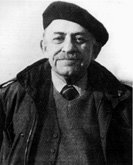
 Rudi Krausmann, Sydney, 1982
Right about now I thought I'd be ascending the steps to Gleebooks Upstairs for this afternoon's launch of Rudi Krausmann's new book 'News'. But unfortunately the event has been postponed until November as Rudi has taken ill. The book, a limited edition collectors' hardback, was to be heralded into the world by antiquarian & specialist bookseller, poet, raconteur and bon vivant (or general 'good guy'), Nicholas Pounder. As a way of wishing Rudi a speedy recovery, I'll post some notes instead of sharing a glass of wine to celebrate his new book.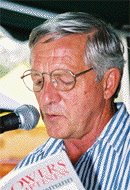 Rudi Krausmann, reading for peace in Paddington, Sydney in 2001 (foto: Annette Willis)Rudi Krausmann was born in Mauerkirchen, Austria, in 1933. He has said that because his mother was German and his father was Austrian he had felt like a stranger in his own country. He studied Economics in Vienna for two-and-a-half years and worked as a journalist for the Austrian newspaper, Salzburger Nachrichten. He came to Australia in the 1960s and he worked variously as a freelance writer and editor, a part-time tutor at the University of New South Wales, a language teacher in Sydney and Melbourne and as a radio broadcaster.
Rudi considers himself to be a German poet writing in Australia and one of his themes is 'exile'. In Sydney in 1975 he founded the influential magazine Aspect: Art and Literature, in an endeavour to interrelate literature and the visual arts. The magazine ran for several years. He was Creative Arts Fellow at the Australian National University in Canberra in 1980 and since then he has been writer-in-residence at several institutions. He returned to Austria in the 1990s, but returned to Australia to live in Sydney. Rudi and his partner, Flis Andreasan, spent six months living in Paris last year. Rudi often asks his friends to illustrate his books. In 2002 I was happy to launch Maps, a bilingual collection of poems with drawings by Andrew Sibley. His latest book News : Fast Flowers, Long Journeys, Cold Funerals that was to be launched today has drawings by noted Sydney artist Garry Shead. It is also a bilingual (English & German) publication with haiku-style poems. The topics range from Germaine Greer to the Sydney Museum of Contemporary Art. Rudi also muses upon fellow poets - both Australian and international - and famous writers, philosophers and artists in a series of 60 short verses which are accompanied by equally succinct and pithy drawings. Together, poet and artist explore the idiosyncrasies and vicissitudes of human nature and of creative lives through the medium of this elegantly bound collectors' edition. It's published by Macmillan Australia and you can buy it at Gleebooks
 In 1994 Rudi collaborated with Gisela Triesch to translate 80 Australian poets into German. Made In Australia was published by Gerald Gangblauer's Gan Gan Books
You can read some of Rudi's poems and find out more about him by typing 'Rudi Krausmann' into the search panel on gangway online magazine. You can also find a list of Rudi's many books and radio and theatre plays and listen to audio files here
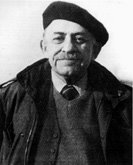 Murray Bookchin 1921-2006
Murray Bookchin, social critic, environmentalist, self-described anarchist and founder of social ecology, died at the end of July.
Six obituaries:
one
two
three
four
five
six
Kate Fagan has announced the new issue of How2
VOYAGE INTO GEOSPACE
Vol. 2 Issue 4
A galactic range of poems, critical reviews and papers... with special features on Pacific poetries, innovation in contemporary Indian writing,'outer alphabets' and London innovation, forums on small press publishing and bookarts, contemporary Chinese poetry in translation and tributes to Barbara Guest
PACIFIC POETRIES + edited by Susan M. Schultz + featuring Tusiata Avia + Pam Brown + Faye Kicknosway + Selina Tusitala Marsh + Deborah Meadows + Meredith
Quartermain + Barbara Jane Reyes + Shin Yu Pai + Hazel Smith + Teresia Teaiwa + Zhang Er + and an interview by Jane Sprague with Susan Schultz on Tinfish Press?
INDIAN INNOVATION * edited by Mani Rao *
featuring Jane Bhandari * Priya Surukkai Chabria * Sampurna Chattarji * Mamang Dai * Minal Hajratwala + Jam Ismail * Kavita Jindal * Smita Rajan * Mani Rao * Archna Sahni * Rati Saxena * Menka Shivdasani * Arundhathi Subramaniam
OUTER ALPHABETS = edited by Kate Fagan =
featuring Jill Magi = Claire Hero = Chris Turnbull = Beth Bretl = Kristi Maxwell = Heather Woods = Marthe Reed = Evelyn Reilly = Mary Kasimor = Britta Kallevang = Arpine Grenier = A. K. Allin = Sascha Akhtar = Mary Michaels = Jennifer Firestone = Cristina Bellodi = Masha Tupitsyn = Megan Jones = Claire Potter = Marie Buck = Ellen Baxt = Jenny Boully = Bronwen Tate = Michelle Detorie = Sarah Vap = Sarah Dowling
LONDON CALLING + edited by Redell Olsen + featuring Rosheen Brennan + Emily
Critchley + Kai Fierle-Hedrick + Kristen Kreider + Frances Kruk + Marianne
Morris + Sophie Robinson + Lydia White
CONTEMPORARY CHINESE POETRY IN TRANSLATION = edited by Zhang Er and Chen Dongdong = featuring Cao Shuying = Lan Lan = Ma Lan = Tang Danhong = Zhang Er = Zhang Zhen = Zhao Xia = Zhou Za
BOOKARTS FEATURE * curated by Susan Johanknecht
* with Sarah Jacobs * Lin Charlston * A C Berkheiser * Sharon Kivland * Heather Weston * Emily Artinian * Anna Trethewey
SMALL PRESS PUBLISHING FORUM = convened by Jane Sprague = Daniel Bouchard = Mary Burger = Allison Cobb = Kristen Gallagher = Jocelyn Saidenberg = Judith Goldman = Rachel Levitsky = Jill Magi = Bill Marsh = Anna Moschovakis = Elizabeth Robinson = Kaia Sand
Plus new work by Linda Mari Walker, Joyelle McSweeney, Ren Powell, Randall Couch
And reviews of Barbara Guest, Kathleen Fraser, Rachel Blau DuPlessis, Brenda Iijima, Catherine Daly, Thalia Field, Andrea Baker, Catherine Wagner, Ann Lauterbach, Elizabeth Willis, Lisa Fishman, Pam Rehm & Gertrude Stein
Editor: Kate Fagan (Sydney)
Managing Editor: Redell Olsen (London)
Designer: John Sparrow (Arizona)
Please visit the new How2 archives
Mark Young, editor of Otoliths has announced the second issue of this eclectic poetry and visual e-zine.
It contains work by Karl Young, Juhana Vahanen (translated by Karri Kokko), Martin Edmond, Rochelle Ratner, Louise Landes Levi, Cath Vidler, Michael Farrell, Christian Jensen, Ira Joel Haber, Bruce Covey, Jill Jones, Allen Bramhall, Derek Motion, Caleb Puckett, Sandra Simonds (a mini-chap —The Tar Pit Diatoms), Vernon Frazer, Pat Nolan, Donald Illich, J.D. Nelson, harry k stammer, Steve Tills, David Meltzer, Tom Beckett, Thomas Fink, Crag Hill, Ira Cohen, Carol Jenkins, Miia Toivio, John M. Bennett, Michael Rothenberg, Geof Huth, David-Baptiste Chirot, Aki Salmela, Sandy McIntosh, Michelle Greenblatt, Janne Nummela, Tom Hibbard, Marko J. Niemi, Phil Primeau, Kevin Opstedal, Olli Sinivaara, Nico Vassilakis & John M. Bennett, Michael McClure, Pam Brown, Leevi Lehto & Eileen Tabios.
Print on demand editions of Otoliths issue one and its associated chapbooks from Jean Vengua and from Ray Craig are available here.
John Tranter has announced issue 30 of Jacket.
It's packed to the gunnels,
or should that be gunwales, as usual.
David Prater announces the latest issue of Cordite - Common Wealth features over fifty new poems by Australian and international poets including Kris Hemensley, Kevin Brophy, Ban'ya Natsuishi, Carol Jenkins, Aileen Kelly, Rebekah Moon, Todd Swift, Diane Fahey and many more
Plus Candylands a special American poetry feature edited by Michael Farrell including poems by Catherine Daly, Kevin Killian, Del Ray Cross, Judith Bishop, Mary Jo Bang and more.
Features and reviews are now posted on a rolling basis - giving you even more reasons to check back to the site. Recent features include Adam Fieled on post-avant poetry and Leanne Hills on rooku and Melbourne's trains. Also, Paul Mitchell reviews Les Murray's 'The Bi-Plane Houses'
Three books I've read recently
 Photo by Jean Mohr
John Berger is 80 years of age this year. There was a kind of festschrift to celebrate and explore his life and work in London, U.K. last year. I've read many of his books but I think my 'favourites' are To The Wedding, a book that deals with AIDS, and King, A Street Story a tale told by a dog who hangs around with a group of homeless people in a junk-filled wasteland beside a motorway in post-Bosnian-war Europe. This new book Here Is Where We Meet, typically, mixes genres and defies categorisation.

In Here Is Where We Meet, a man named John meets the ghost of his late mother in Lisbon. He travels throughout Europe, visiting the ghosts of those who have influenced his life. He meets a friend from his war years in London, in Krakow he meets the older man who introduced him to books and sex, and in Madrid he finds the schoolmaster who taught him how to write. The ghosts have each chosen the city for their afterlife that best suits them. John Berger's novel is an exploration of this past that makes both a person and a city or civilization. Here Is Where We Meet has received positive reviews with the 'New Statesman' saying, 'Formally, Here Is Where We Meet is recognisably a genre that Berger long ago made his own: the rich amalgam of novel, essay and autobiography.'
You can read multiple reviews of Here Is Where We Meet.

The publisher, Scribe, describes Herzl's Nightmare this way:
'Theodor Herzl's dream of a national homeland for the Jewish people was realised when Israel declared its independence in 1948 - a triumph achieved in little more than half a century. Yet it was made possible only through the deaths of millions of European Jews and at the expense of Palestinian society. Whatever their historical claim or emotional attachment to the land they came to rule, the Jews of Israel had supplanted another people - a people who would not forget what they saw as a grave injustice. Herzl's dream of ending Jewish insecurity, once and for all, would prove illusory.
While the story of the conflict between Jew and Palestinian in the past century has its share of both political and military and human triumphs, too often the recurring themes are those of lies and hypocrisy, myth-making and mutual demonisation and of a determined, energetic refusal to contemplate and acknowledge the other's history and point of view.
This important new study shows how little the dynamics of the conflict have actually changed; how eerily reminiscent today's antagonisms and falsehoods are of yesteryear's; how 'modern' leadership is anything but; and how much today's self-righteous intransigence owes to what went before. Peter Rodgers brings a rare understanding of the recent history of the region to explain with fair-minded clarity the nightmare of modern Israel and Palestine.'
The Australian author, Peter Rodgers, is a former journalist and an Ambassador to Israel.

Rachel Loden has kindly sent me the annual of poetry and poetics New American Writing - 24 for 2006.
It's a solid read - a mix of poetry edited by Maxine Chernoff and Paul Hoover and with a great big barcode on the front cover, just below the underwater image from Bill Viola's video The Messenger.
There's a feature on Nathaniel Mackey, poetry by Nguyen Trai, Neruda, Holan, Lopez-Colome and many usual and unusual suspects - Pierre Joris, Rosemary Waldrop, Douglas Messerli, Noelle Kocot and Andrew Early. That list covers only some the contents.
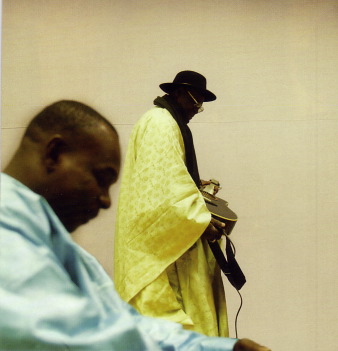
Meanwhile, the music of Burkina Faso-born Cheikh LÔ and Malians Ali Farka Touré who died last year, and the griot Toumani Diabaté has been warming the wintry air in the little flat we inhabit in Rose Bay, Sydney.
The CD titles are Lamp Fall and In The Heart of the Moon
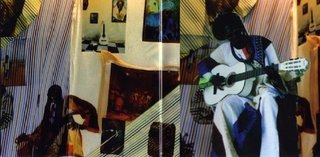 Cheikh LÔ
 Toumani Diabaté and the late Ali Farka Touré

 Tuesday 25.7.07 News of the day :
Washington plans to deliver a hundred 'bunker buster' bombs to Israel to kill Hassan Nasrallah, the leader of the Lebanese resistance movement Hezbollah, and destroy their group trenches.
Beezer, a young web designer from Bekaa, Lebanon, who is currently sheltering in Jordan is keeping a blog
Lebanon Israeli Crisis.
analysis & updates and electronic intifada
Human Rights Watch Lebanon
APHEDA appeals for Mid-East donations :
'Ordinary Palestinian, Lebanese and Israeli families are suffering from a military conflict that must cease' says the ACTU (Australian Council of Trade Unions).
Sharan Burrow, ACTU president, says 'Union Aid Abroad - APHEDA has two appeals for humanitarian assistance, one for families in the Gaza Strip and another for families in Burj el-Barajneh refugee camp in Lebanon. I urge people to make donations to these appeals - please ring 1800 888 674 or access APHEDA'.
John Mateer was born in Johannesberg, South Africa. He grew up there and in Canada. Prior to being conscripted during the State of Emergency in South Africa, he moved with his parents to Western Australia in 1989 and then to Melbourne in 1998. Twelve years ago he remarked that he had occasionally written in Afrikaans 'in order to examine more fully what it means to be African'. (Fremantle Arts Review, Aug/Sept 1994) John has published five collections of poems in Australia, and several chapbooks in Australia, South Africa, Indonesia and most recently Japan: among them Barefoot Speech, Loanwords, and the 2005 book I've only just read, The Ancient Capital of Images. John has been writer-in-residence in North Sumatra, Indonesia, at the School of Contemporary Art (Western Australian Academy of Performing Arts), Australia, and in 2002 in Kyoto, Japan. He is also an art critic, contributing regularly to several national Australian art magazines. John moves around a lot but currently he has returned to one of his more frequent places of residence, Perth, Western Australia.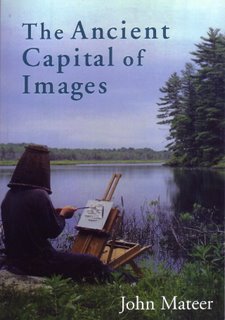 The strange, yet beautiful, cover photo is a detail from Melbourne-based artist Domenico de Clario's performance Crown Chakra on Sabbath Day Lake, Maine, USA in 1996.
The poems in this slim book are keen in perception, intense in both thought and feeling and sometimes almost bleakly droll as John Mateer moves around in Africa, Australia and Japan locating images, ghosts and feelings from his past in Cape Town and from recent sojourns in Melbourne and Kyoto.
Five Artefacts Found On The Highveld
Keys
Rattle those keys, the whole bossie, and hear
how the metal is a silver skeleton and the corridor
of your inner ear a city of shattered glass for you to sprint across
Razor-wire
And that razor-wire, more than doringdraad
that a giraffe's black chewing-gum tongue could circumvent without touching,
is invisible, car-jackers, makwerewere everywhere in your head
Chains
Let those chains be a memorial to heavy industry and the zoo
and to the home since they are metaphor, tethered to thought
as a dog to the tokeloshe and ground to its owner
Electric Fences
on summer afternoons lightning used to hunt down thatched houses,
but electrified fences are its avatars now
and the whole city a gamepark
Walls
Stones: hardly less than the Ruins of Great Zimbabwe,
these walls broken like the crusty bread of a bunny-chow chucked
from the back of a speeding bakkie.
excerpt from The Deepest North
2. On Asahi-dake
The rock is large enough to block the wind if I crouch down
like a primitive man inventing shelter. I do.
And from here on Asahi-dake my view is of the distant mountain range
and a nearby gravel slope where, with streaming smoke,
the Earth is pouring into the grey sky and howling endlessly
jet-engine harsh through the holes of its volcanic vents, its exhausts.
Whole industrial cities could be buried here under the rubble
right up to the tips of their smokestacks.
Why do mountains always miniaturise the human,
reduce us to an imagining ?
I wait there until the mist descends,
then wander the stony paths until I am lost in the whiteness.
The book is published by
Fremantle Arts Centre Press
You can read an interview with John Mateer made in Melbourne, Victoria, five years ago in 2001.
News from Adelaide:
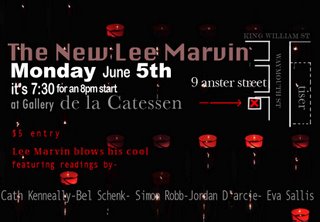
The regular Lee Marvin Reading Series continues in the 'Athens Of The South'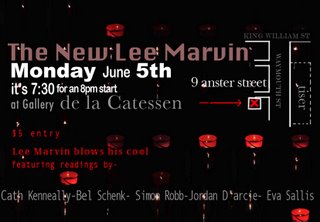
THE LEE MARVIN READINGS
Mondays
at Gallery de la Catessen
9 Anster St., Adelaide
(off Waymouth at the King William end, near FAD nightclub)
7.30 for 8 PM start
Price $5
August 7th:
LEE MARVIN IN A LONELY PLACE
Cath Kenneally
ADEEB KAMAL AD-DEEN Iraq
Rachel Manning
Kate Deller-Evans
Ros Prosser
August 14:
LEE MARVIN IN A MELLOW MOOD
Stephen Lawrence
Jason Sweeney
RACHEL HENNESSY
CAROL LEFEVRE
Linda Marie Walker
August 21:
LEE MARVIN IN A GADDADAVIDA
Moya Costello
Simon Robb
Gail Walker
STEPHEN WHITTINGTON:
John Cage'sOverpopulation & Art (1992)
KEN BOLTON:THE CIRCUS
August 28:
LEE MARVIN IN A PURPLE HAZE
RAY LIVERSIDGE (Vic)
Pru La Motte
Cath Kenneally
Francesca Da Rimini
KEN BOLTON:THE CIRCUS
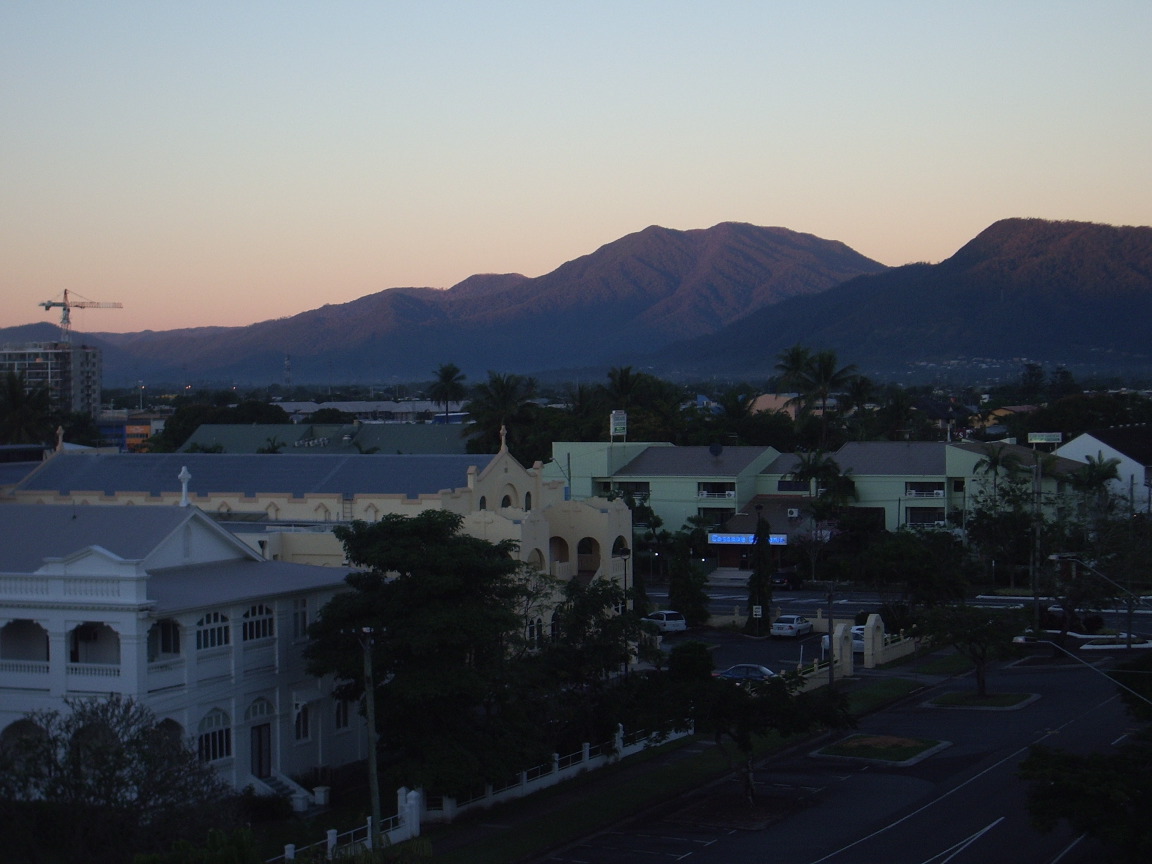
After a few days in Brisbane, we drove north to Buderim, Peregian, Noosa and Yandina on the Sunshine Coast and the hinterland. Then we headed up to Far North Queensland. Early morning, Cairns, QLD July 2006
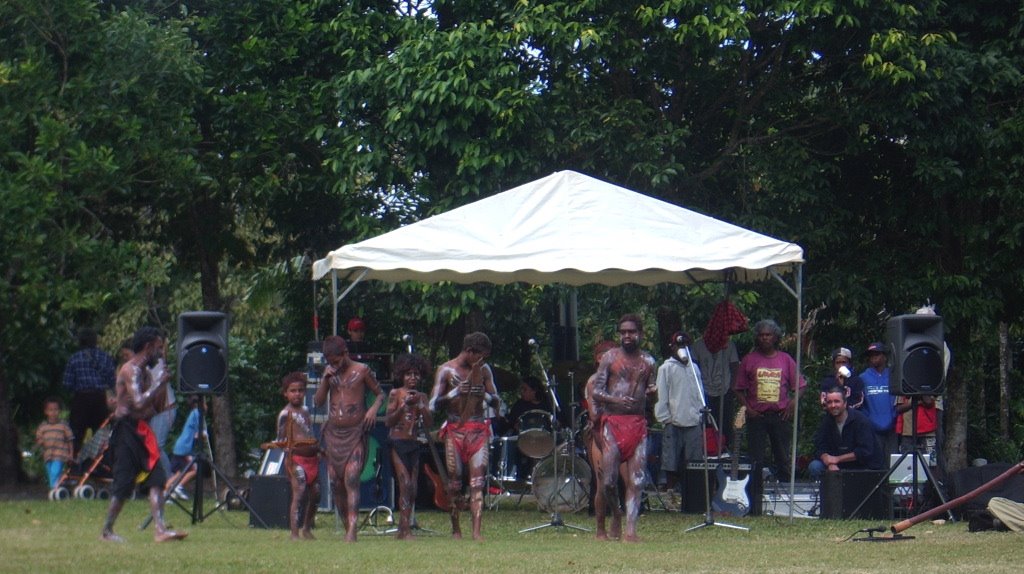
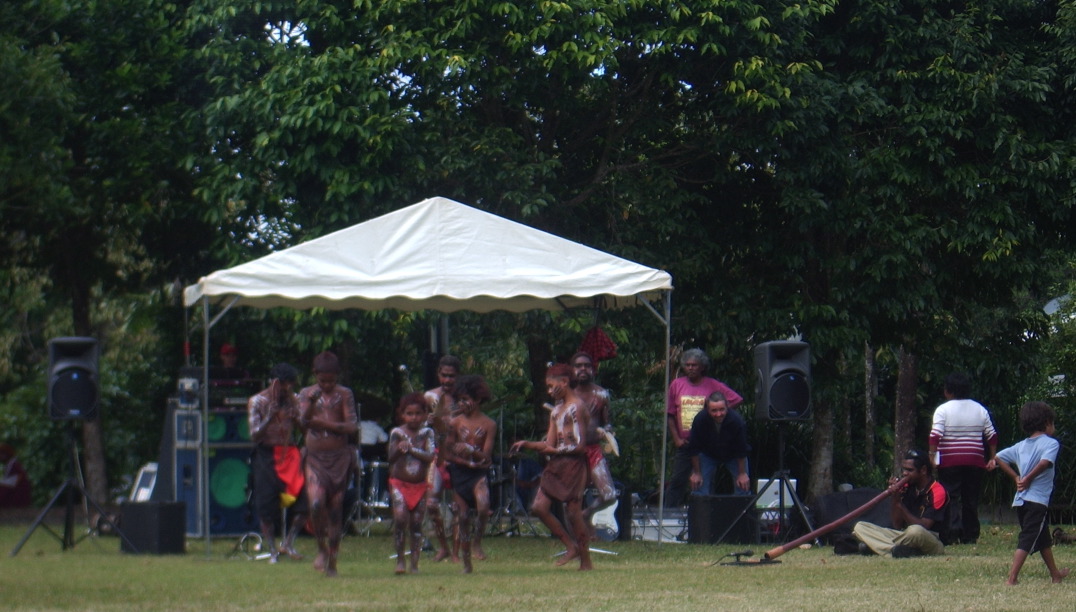
This year Cairns was the focus city for NAIDOC WEEK (a week of celebrations organised by the National Aborigines and Islanders Day Observance Committee).
We were in Kuranda, north west of Cairns, on July 6th for their celebrations and the next day we attended the big gathering on the esplanade park beside the Cairns waterfront.


Warranbi (Welcome) Dance and Cassowary Dance, Kuranda, July 2006
In Cairns we visited a couple of Indigenous art exhibitions that were also part of NAIDOC week.

Print by Joey Laifoo, 2006
Gatherings, a survey exhibition of works by Queensland Indigenous Artists including Arone Meeks, Joey Laifoo and others is on at Kick Arts in the Centre Of Contemporary Arts, or COCA. The impressively huge woodcuts in this exhibition are stunning.
Gatherings catalogue launch
Book Launch: 5:00pm Wednesday 26 July 2006 TBC
Exhibition continues: to Saturday 5 August 2006
Time: 10:am - 5:00pm Tuesday to Saturday
Where: KickArts Lower Gallery
Price: Free Entry, All Welcome
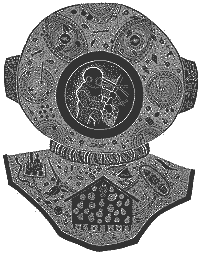
 Over at the Cairns Regional Gallery there was an exhibition of responses to and re-interpretations of nineteenth century King breastplates called Unreal Shields. The work here was by a range of Indigenous artists who had participated in etching workshops at Cairns TAFE and Banggu Minjaany Centre earlier this year. Crescent-shaped brass breastplates were conferred by the Australian government in the nineteenth century to acknowledge the leadership and authority of the wearer.
The photo here is of six year old Jager Kemp,the great great great grandson of 'King Billy' Jagar, a Yirriganydji elder of the Barron River, north west of Cairns and of 'King Billy' himself - both wearing the breastplate from 1898.
Breastplates were first introduced by Governor Macquarie of New South Wales around 1815. They can be read as a means of controlling Indigenous people. To quote from Macquarie's set of instructions to the 'Native Institution' in Parramatta, Sydney - That the Natives should be divided into District Tribes and that each Tribe should elect its own chief, who the Governor will distinguish by some honorary badge . The chief or, more usually, 'King', was then to be held accountable for the general conduct and reconciling of any grievances within his tribe.

'King Billy' Jagar, a Yirriganydji elder, 1925

Catalogue Cover - Unreal Shields
This is a complex, very moving and diverse exhibition. The artists have used the motif of the breastplate to tell stories of their own.

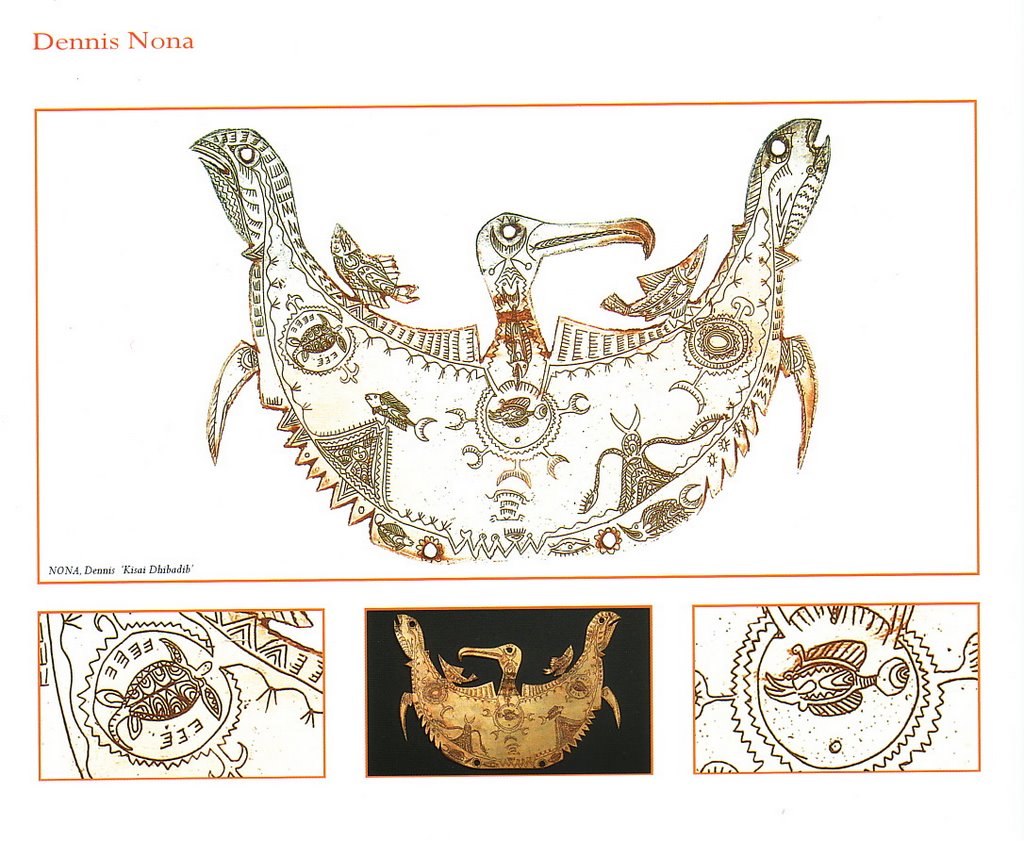
Kisai Dhibadid by Dennis Nona, Badu Island (he now lives in Brisbane)
Dennis Nona writes about his etching -Before the mission times, Badu Island warriors made head-hunting raids on other islands. So fast were their canoes, they were likened to the very fast Kuparik bird. Their image was often carved into the prows of their canoes
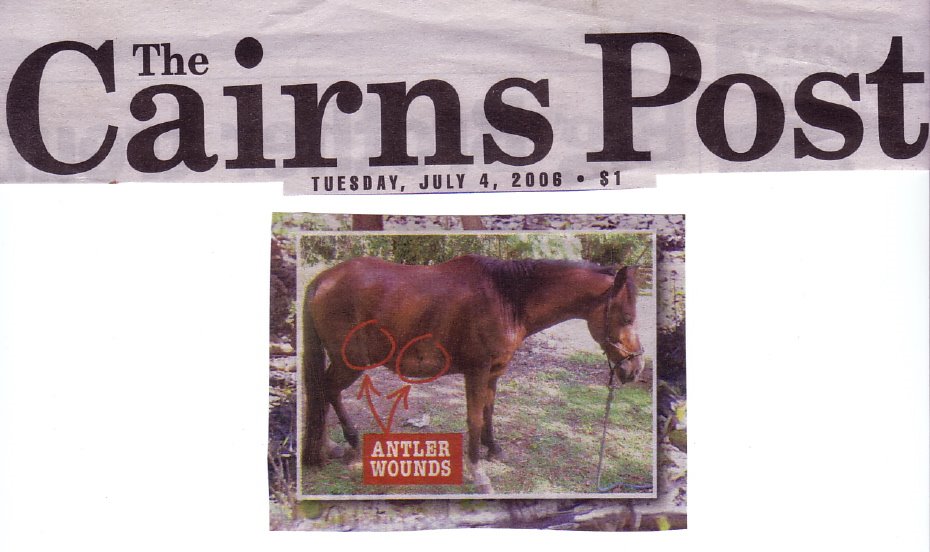
Meanwhile, as regular reading revealed, the redoubtable Cairns Post seemed to be on another planet entirely.


 Brisbane River
Teneriffe, July 2006
Who would think, walking along the placid Brisbane River at sunset on a winter evening, that this city was once a hotbed of decades of protest and dissent ?
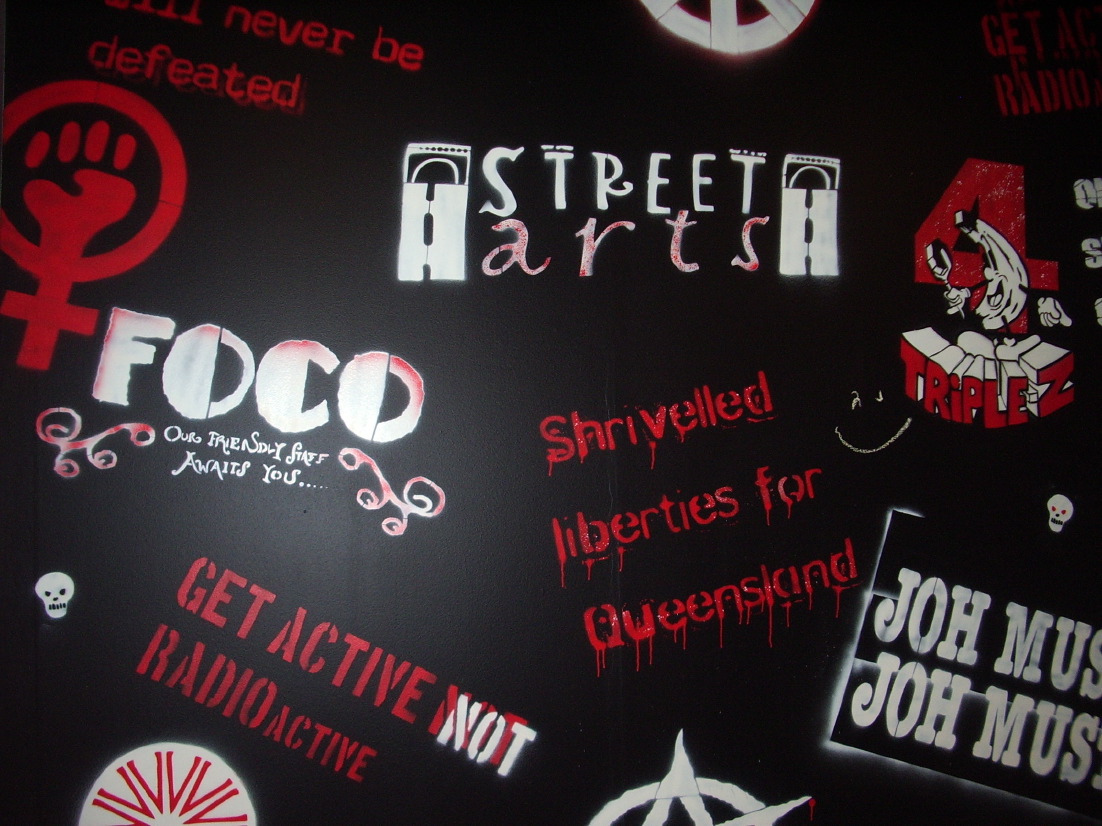
I was a young political activist, still attending Mitchelton High School in Brisbane, when FOCO began. 1965 until 1985 was one of the most divisive and extraordinary times in Queensland history. A period when it was at times illegal to protest publicly, and when the anti-Vietnam War movement was gathering strength. In Queensland, legislation was used to enforce conservative social values, the state government pursued economic development above all and clashes between protestors and police were a part of everyday life. FOCO was started when the Trades Union Movement perceived a lack of space devoted to the cultural activities of young people. The entire top floor of the now-demolished Trades Hall (an uninspiring IBM high rise office block now occupies the site) was made available to FOCO for music (hosting all night concerts by bands like Lobby Lloyd and the Coloured Balls, Max Merrett and the Meteors alongside folk singers like Declan Affley, Barbara Bacon, Jeannie Lewis etc), alternative theatre (the legendary group Tribe began there), poetry readings, art shows, happenings and so on. I participated in many events (until I quit Brisbane for Sydney in late 1968).

Wall display, Museum of Brisbane, 2006
It was a stirring experience to visit the exhibition Taking To The Streets documenting the years of dissent from 1965 until 1985. It's a multi-media social history exhibition covering anti-war demos, land rights and indigenous issues, homosexual and lesbian rights, the right to demonstrate, workers' rights, womens' rights, student politics, union politics - the right to strike and so on.

The exhibition runs until 10th September 2006
Free Entry Open every day 10am to 5 pm
at the Museum of Brisbane
Ground Floor,
City Hall, King George Square
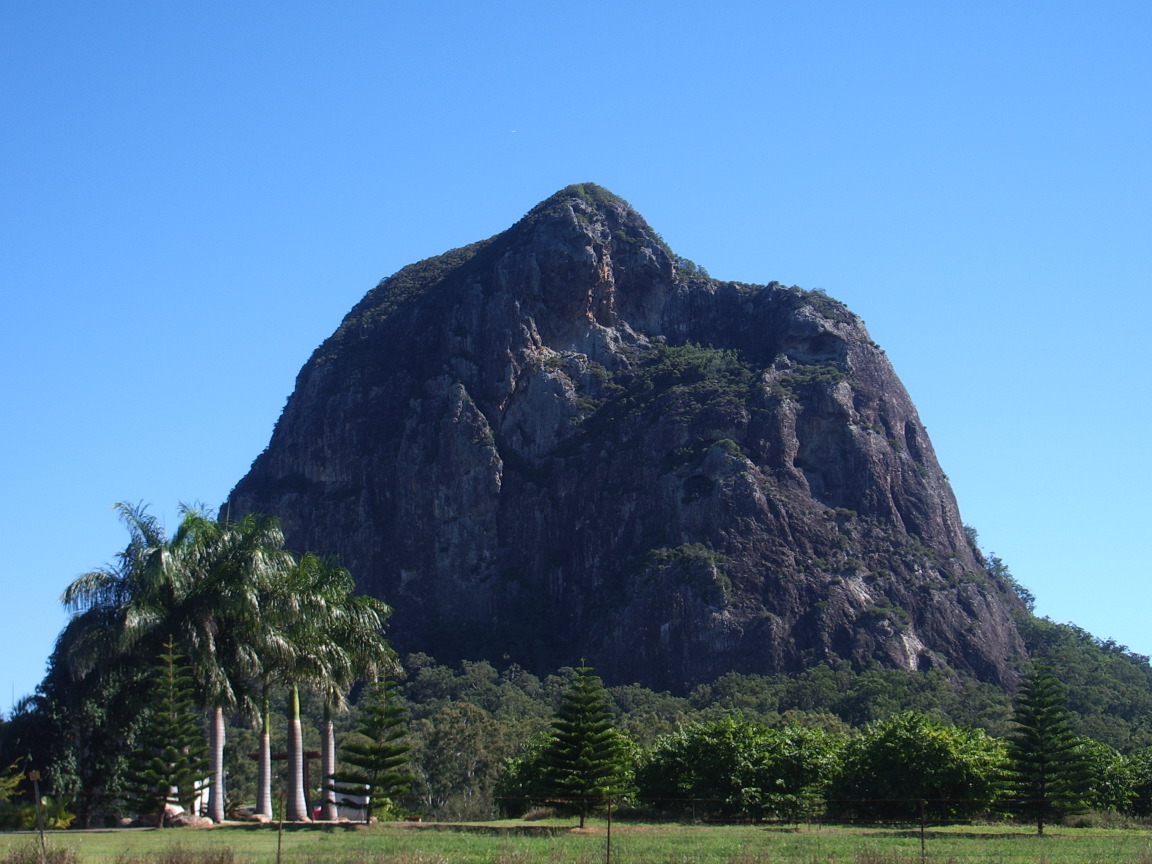
The grand volcanic plugs of the Glass House Mountains have always held personal meaning for me. On Boxing Day, 1965, my politically active and mountain climbing friends and I travelled up to the Glass House Mountains, 61 kilometres north of Brisbane, and climbed Mount Tibrogargan. Mountain climbing was one of my pastimes - sounds odd for a Bob Dylan/Woody Guthrie fan and prospective anarchist, I know - but it's a fact. At only 364 metres, Tibrogargan is smaller than other mountains I climbed back then (for instance Mount Lindesay, the crumbling mountain, near the NSW border at 1117 metres high). This time, forty years later, we stopped for a roadside picnic with the Glass House Mountains in view.

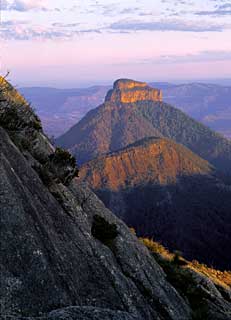
Mount Lindesay, QLD
(foto - Robert Rankin)

Mount Tibrogargan, July 2006
A note - all fotos on The Deletions are by PB unless credited otherwise
G O N E T R O P P O I'm going on a winter holiday
to Far North Queensland.
Back in mid-July.





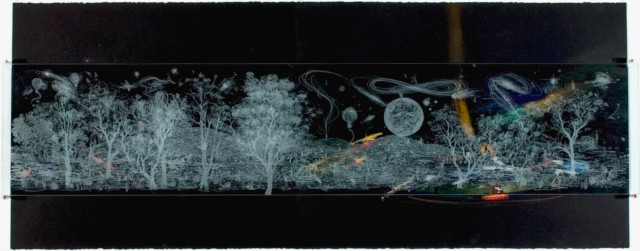 Night 1, 2005 - engraved glass panels over pastel on paper
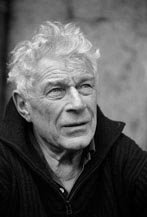 Photo by Jean Mohr


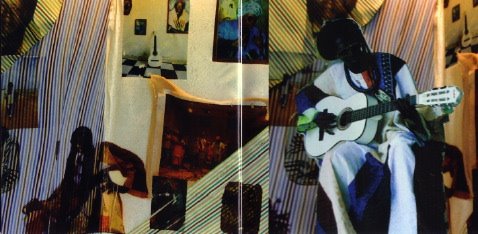 Cheikh LÔ
 Toumani Diabaté and the late Ali Farka Touré


 Over at the Cairns Regional Gallery there was an exhibition of responses to and re-interpretations of nineteenth century King breastplates called Unreal Shields. The work here was by a range of Indigenous artists who had participated in etching workshops at Cairns TAFE and Banggu Minjaany Centre earlier this year. Crescent-shaped brass breastplates were conferred by the Australian government in the nineteenth century to acknowledge the leadership and authority of the wearer.




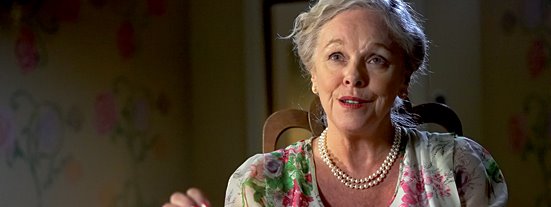 Lynette Curran in Call Me Mum
 Margot Nash
 Kathleen Mary Fallon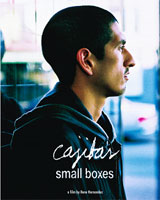
 Demian Iturra in Small Boxes

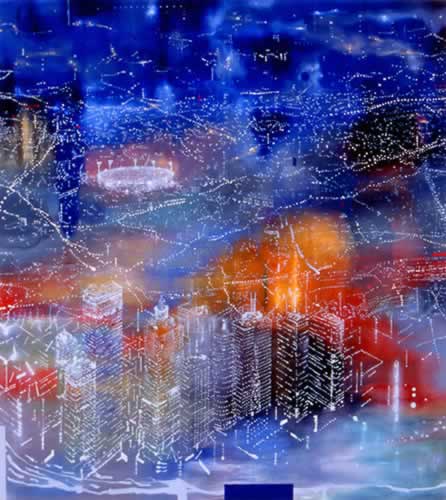 One panel of the large triptych The Melbourne Panels, 2003